
Introduction
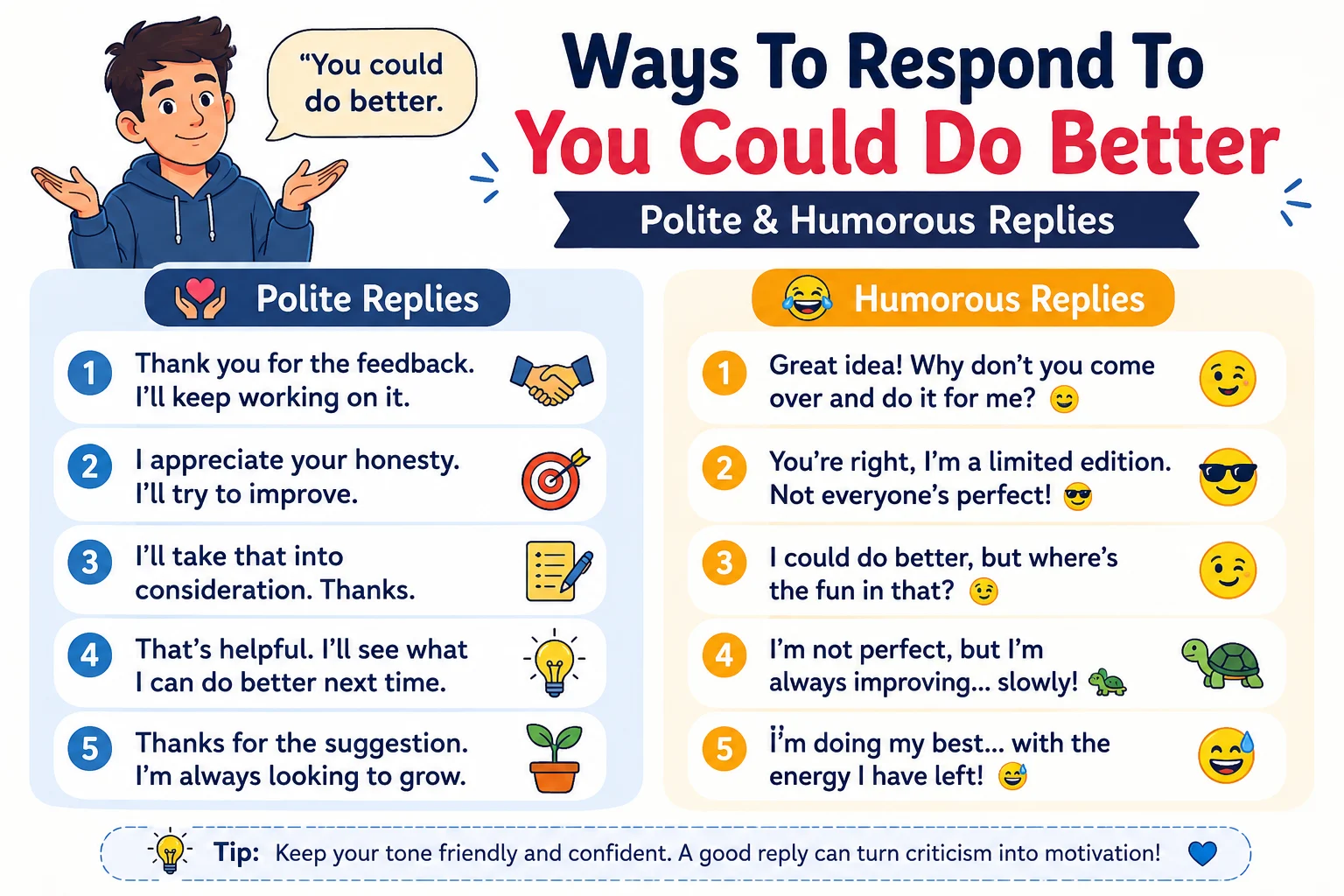
Ways To Respond To You Could Do Better Polite Humorous Replies can help you handle an awkward comment without turning a simple conversation into an unnecessary argument. When someone says, “You could do better,” it can sound supportive, teasing, judgmental, sarcastic, or even insulting depending on the situation.
Maybe your friend is joking about your questionable movie choice. Perhaps a coworker is commenting on your work. Maybe someone is criticizing your dating choices. Or perhaps a person simply wants to make you feel like you’re not good enough.
Whatever the situation, your response matters.
You don’t always need a savage comeback. Sometimes the smartest answer is polite. Sometimes humor works better. Sometimes confidence is the right approach, while other situations call for a clear boundary.
The trick is understanding why the person said it and matching your response to the tone.
A good comeback doesn’t have to hurt someone. It can make them laugh, show that you’re confident, or simply communicate that their comment doesn’t bother you.
This guide covers funny responses, polite replies, witty comebacks, sarcastic answers, flirty responses, workplace-friendly options, short text replies, and confident responses when the comment genuinely crosses a line. For more insights, read here:- My Girlfriend Is Always On Her Phone Reasons Why and Best Responses To You Have Big Shoes To Fill.
Quick Summary Box: Best Ways To Respond To You Could Do Better Polite Humorous Replies
If you need a response immediately, here are some of the best options:
- Polite: “Thanks for the feedback. I’ll keep working on it.”
- Funny: “I was saving my best work for the sequel.”
- Witty: “Fortunately, I’m still a work in progress.”
- Confident: “I know. That’s why I’m always improving.”
- Playful: “This was only the preview.”
- Sarcastic: “Thanks for the performance review.”
- Short: “Challenge accepted.”
- Flirty: “Maybe I already found better.”
- Professional: “What specifically would you suggest I improve?”
- Lighthearted: “Give me time. Version 2.0 is coming.”
- Clever: “I could, but then I’d have to raise expectations.”
- Boundary-setting: “I’m open to feedback, but I’d appreciate some respect.”
The best response depends on the relationship, setting, tone, and intention behind the comment.
What Does “You Could Do Better” Mean?
Before choosing one of the best ways to respond, consider what the phrase actually means.
“You could do better” isn’t automatically an insult.
Sometimes it’s genuine encouragement. A teacher might say it because they know you can achieve more. A manager might say it because your work has potential. A friend might tell you that because they believe you made a poor choice.
But the phrase can also be dismissive.
Someone might say it after seeing your partner, your outfit, your work, your decision, or even your cooking. In that context, it can feel judgmental.
Then there is the joking version.
Your friend could look at your terrible karaoke performance and say, “You could do better.” They’re probably not expecting a serious discussion about personal development.
Consider these possibilities:
- They are genuinely offering advice.
- They are teasing you.
- They are disappointed.
- They are trying to motivate you.
- They are criticizing your performance.
- They are comparing you with someone else.
- They are being sarcastic.
- They are trying to start an argument.
- They are flirting or playfully challenging you.
- They are deliberately putting you down.
The same words can therefore require completely different answers.
15 Polite Responses to “You Could Do Better”
When someone is giving legitimate feedback, there’s no reason to respond aggressively.
A respectful answer can show maturity while leaving room for improvement.
- “Thanks for the feedback. I’ll work on it.”
- “I appreciate you pointing that out.”
- “That’s fair. I’ll take another look.”
- “I understand what you mean.”
- “I’ll keep that in mind.”
- “Thanks for being honest with me.”
- “I appreciate the suggestion.”
- “I’ll see where I can improve.”
- “That’s something I’ll work on.”
- “Good point. I’ll give it another try.”
- “I appreciate the constructive criticism.”
- “You’re right that I have room to improve.”
- “I’ll take your advice into consideration.”
- “Thanks. Specific feedback would be helpful.”
- “I understand. I’ll try to do better next time.”
Why these responses work
Politeness doesn’t mean admitting that the other person is completely right.
You can accept feedback without accepting a negative judgment about yourself.
For example, saying, “I appreciate the feedback” doesn’t mean you’re saying, “Everything you said about me is correct.”
It simply keeps the conversation constructive.
Real-life scenario
Coworker: “You could do better on the presentation.”
You: “Thanks for the feedback. Which part do you think needs the most improvement?”
That’s much more productive than immediately responding with an insult.
15 Funny Replies to “You Could Do Better”
If someone is joking with you, humor can be the perfect answer.
These responses keep things light:
- “I could, but I didn’t want to show off.”
- “This was the free trial.”
- “My premium version hasn’t launched yet.”
- “I was saving my best work for later.”
- “That was only the warm-up.”
- “Give me five business days.”
- “Version 2.0 is currently under development.”
- “I prefer to keep expectations realistic.”
- “I was working with a limited budget.”
- “This is what happens when I skip breakfast.”
- “Don’t worry. My comeback is loading.”
- “I call this the rough draft.”
- “I wanted to leave some room for improvement.”
- “My talent took the day off.”
- “I was giving everyone else a chance.”
Real-life example
Friend: “You could definitely do better.”
You: “I could, but then you’d have nothing to complain about.”
It’s humorous, confident, and playful without becoming genuinely hostile.
15 Witty Responses That Sound Clever
Sometimes you want something more intelligent than a standard joke.
A witty comeback acknowledges the comment while subtly turning the situation around.
- “Fortunately, I’m not finished improving.”
- “That’s what makes progress interesting.”
- “I appreciate your confidence in my potential.”
- “I suppose perfection would get boring.”
- “I’ll add that to my collection of opinions.”
- “That’s one interpretation.”
- “I’ll consider that professional review.”
- “Interesting. I’ll take that under advisement.”
- “Potential is usually more interesting than perfection.”
- “I prefer progress over perfection.”
- “Future me is already working on it.”
- “That’s precisely why there’s always a next attempt.”
- “I’ll let the results speak for themselves.”
- “I haven’t reached my final form yet.”
- “Good. That means there’s still room to surprise you.”
These are useful when you want to sound self-assured without being unnecessarily rude.
15 Playful Responses for Friends
Friends often criticize your decisions simply because they enjoy teasing you.
If you have a comfortable relationship, playful humor can work extremely well.
Try these:
- “That’s why you’re my unpaid consultant.”
- “I knew you’d have an opinion.”
- “Your review has been recorded.”
- “Thanks, Professor.”
- “I’ll schedule an improvement meeting.”
- “Your concern has been noted.”
- “I appreciate your completely unbiased opinion.”
- “You’re lucky I value your feedback.”
- “I’ll pretend that didn’t hurt.”
- “I was testing your patience.”
- “Don’t worry. I’ll disappoint you differently next time.”
- “You really came prepared today.”
- “I knew this friendship came with performance reviews.”
- “Five stars for honesty. One star for delivery.”
- “I’ll consult you before making any more questionable decisions.”
Why playful responses work
With close friends, teasing is often part of the relationship.
The objective isn’t to win an argument. It’s to keep the interaction entertaining.
15 Flirty Responses to “You Could Do Better”
When romance is involved, the phrase can take on an entirely different meaning.
If someone tells you that you could find someone better, they may be testing your interest, teasing you, or expressing insecurity.
A playful response can turn the moment into flirtation.
- “Maybe I already found better.”
- “Are you volunteering?”
- “You seem pretty interested in my options.”
- “Maybe better is standing right here.”
- “I think I’m exactly where I want to be.”
- “Why? Are you applying for the position?”
- “Maybe my definition of better is different.”
- “Careful. That almost sounded jealous.”
- “Perhaps I already have my upgrade.”
- “I haven’t seen a better option yet.”
- “You sound like you want the job.”
- “Maybe you’re the better option.”
- “I could, but I like my current choice.”
- “You’re making a pretty strong case for yourself.”
- “Maybe I should let you prove it.”
Use these carefully
Flirty responses only work when the relationship already has some romantic or playful chemistry.
If someone is discussing a serious relationship problem, a joke may come across as dismissive.
Always read the room.
15 Sarcastic Replies Without Going Too Far
Sarcasm can be effective, but there is a difference between playful sarcasm and outright hostility.
If the person is being unnecessarily critical, try controlled sarcasm:
- “Thanks for the performance review.”
- “I’ll forward your feedback to management.”
- “Your opinion has been officially received.”
- “I’ll alert the committee immediately.”
- “Thank you for this groundbreaking observation.”
- “I’ll try to recover from that.”
- “I’ll be sure to lose sleep over it.”
- “Your approval means everything.”
- “I’ll put that on my list of urgent concerns.”
- “I didn’t realize this was an audition.”
- “Thanks for keeping me humble.”
- “I’ll add your review to the archives.”
- “I’ll consult you next time.”
- “Your dedication to criticism is impressive.”
- “I’ll frame that feedback.”
A useful rule
If the other person is laughing, your sarcasm is probably landing.
If they’re becoming angry, defensive, or uncomfortable, stop escalating.
A clever comeback should make the situation better—or at least prevent it from becoming worse.
Confident Responses When Someone Is Putting You Down
Sometimes “You could do better” isn’t constructive criticism.
It is simply an attempt to make you feel inadequate.
In that situation, confidence matters more than humor.
Try:
- “I’m comfortable with where I am.”
- “I know what I’m capable of.”
- “I’m working on myself at my own pace.”
- “I appreciate your opinion, but I disagree.”
- “I’m happy with my progress.”
- “I don’t need everyone’s approval.”
- “I’ll decide what works for me.”
- “You don’t have to agree with my choices.”
- “I’m still learning, and that’s okay.”
- “I know I can improve.”
- “I don’t measure myself by someone else’s standards.”
- “I’m comfortable making my own decisions.”
- “I appreciate the concern, but I’m good.”
- “I’ll take useful feedback and leave the rest.”
- “My choices don’t need your approval.”
Why confidence is powerful
A confident response doesn’t necessarily mean having the perfect comeback.
Sometimes confidence is simply refusing to become defensive.
You don’t need to convince everyone that you’re doing well.
Professional Replies for Work and School
Workplace and academic conversations require more careful wording.
If a manager, teacher, supervisor, or colleague says you could do better, ask for specific information.
Useful responses include:
- “What specifically could I improve?”
- “Which area should I focus on?”
- “Could you give me an example?”
- “I’d appreciate some specific feedback.”
- “What would a stronger version look like?”
- “I’ll review it and make improvements.”
- “Thanks. I’ll work on those areas.”
- “What should I prioritize?”
- “I’d like to understand your expectations.”
- “I’ll make the necessary changes.”
- “That’s helpful feedback.”
- “I’ll take another look.”
- “Let’s identify the biggest improvement opportunity.”
- “I appreciate the guidance.”
- “I’ll use that feedback for the next version.”
Real-life scenario
Manager: “You could do better with these reports.”
Employee: “I’d like to improve them. Could you tell me which areas need the most attention?”
This response shows professionalism and turns vague criticism into actionable information.
Short Responses to “You Could Do Better”
Sometimes you don’t need a paragraph.
Especially in texting, a short response can be more effective.
Here are quick options:
- “Challenge accepted.”
- “Fair enough.”
- “Noted.”
- “Maybe.”
- “Watch me.”
- “We’ll see.”
- “That’s the plan.”
- “Give me time.”
- “I’m working on it.”
- “Eventually.”
- “Stay tuned.”
- “Probably.”
- “Bold assumption.”
- “Interesting.”
- “Point taken.”
- “Good feedback.”
- “I’ll consider it.”
- “Maybe next time.”
- “Version 2.0.”
- “We’ll improve.”
Short replies work because they don’t give unnecessary attention to the criticism.
Responses When “You Could Do Better” Hurts
Not every situation needs humor.
If the comment genuinely hurts you, it’s completely reasonable to say so.
Consider:
- “That sounded a little harsh.”
- “I understand your point, but I didn’t appreciate how you said it.”
- “You could have said that more respectfully.”
- “I’m open to constructive feedback.”
- “I’d rather discuss this without insults.”
- “What exactly do you mean?”
- “I’d appreciate specific feedback.”
- “That comment wasn’t particularly helpful.”
- “Let’s keep this constructive.”
- “I’m willing to listen if you’re trying to help.”
- “I respect your opinion, but I don’t agree.”
- “I’d rather understand your reasoning.”
- “Please explain what you think I could improve.”
- “I’m open to suggestions, not personal attacks.”
- “Let’s have a productive conversation about it.”
Why this approach matters
A vague criticism can make you feel as though your entire effort has been dismissed.
Instead of reacting emotionally, ask for specifics.
The question “What exactly could I do better?” forces the conversation toward something measurable.
Savage but Controlled Comebacks
There are moments when a little attitude is appropriate.
The key word is controlled.
You want something memorable without becoming cruel.
- “And yet, here you are still watching.”
- “I didn’t realize your approval was required.”
- “That’s an interesting amount of confidence.”
- “I’ll consider that when I need entertainment.”
- “Thanks for setting ambitious expectations.”
- “I wasn’t aware this was a competition.”
- “You seem unusually invested.”
- “I’ll take that under consideration.”
- “Fortunately, I’m not applying for your approval.”
- “That’s one opinion among many.”
- “I can live with your disappointment.”
- “I’ll survive somehow.”
- “Good thing we’re allowed to disagree.”
- “I’ll add it to the list.”
- “You really wanted to say that, didn’t you?”
These are best reserved for casual situations where a little edge won’t create a larger problem.
How to Choose the Perfect Response
The smartest comeback isn’t necessarily the funniest one.
It is the response that fits the situation.
If they’re joking
Use humor.
Example:
“I was saving my best work for later.”
If they’re giving genuine advice
Be receptive.
Example:
“Thanks. What would you recommend improving?”
If they’re flirting
Use playful confidence.
Example:
“Maybe I already found better.”
If they’re criticizing your work
Ask for specifics.
Example:
“Which part should I improve?”
If they’re insulting you
Set a boundary.
Example:
“I’m open to feedback, but I’d appreciate respect.”
If you don’t understand their intention
Ask:
“What makes you say that?”
That simple question is one of the most useful responses because it makes the other person clarify their meaning.
Common Mistakes to Avoid
Even a good comeback can become a bad response if the delivery is wrong.
Avoid these mistakes:
1. Overreacting
If someone is clearly joking, getting angry can make the situation unnecessarily awkward.
2. Insulting them immediately
A harsh response may turn playful teasing into an actual argument.
3. Explaining yourself too much
You don’t need a five-minute defense of every decision you make.
4. Using sarcasm at work
Professional environments usually require more measured language.
5. Ignoring genuine feedback
Not every criticism is an attack.
6. Trying too hard to sound clever
A simple “Fair enough” can be more effective than a complicated comeback.
7. Matching negativity with more negativity
You can be confident without becoming hostile.
8. Taking every comment personally
People often speak casually without realizing how their words sound.
9. Forgetting the relationship
The same joke can sound funny from a close friend and offensive from a stranger.
10. Continuing after the joke is over
If the conversation becomes serious, change your tone.
Best Responses by Situation
Here’s a quick reference guide for choosing your answer.
| Situation | Recommended style | Example |
|---|---|---|
| Close friend teasing | Funny | “This was just the preview.” |
| Crush flirting | Playful | “Maybe I already found better.” |
| Coworker feedback | Professional | “What specifically could I improve?” |
| Boss criticism | Respectful | “Thanks. I’ll work on that.” |
| Stranger insulting you | Confident | “I appreciate your opinion.” |
| Partner discussing a concern | Honest | “Tell me what you think I should improve.” |
| Casual text | Short | “Challenge accepted.” |
| Friendly competition | Witty | “I was giving you a head start.” |
| Serious criticism | Direct | “I’d appreciate specific feedback.” |
| Obvious sarcasm | Sarcastic | “Thanks for the performance review.” |
The context should always determine the comeback.
Related Search Questions
People looking for Ways To Respond To You Could Do Better Polite Humorous Replies often have related questions about dealing with criticism, teasing, and clever comebacks.
What is a polite response to “You could do better”?
A good response is:
“Thanks for the feedback. I’ll keep working on it.”
It acknowledges the person’s comment without automatically agreeing with their judgment.
What is a funny reply to “You could do better”?
Try:
“I could, but I didn’t want to show off.”
Another playful option is:
“That was only the preview.”
What is a confident response to “You could do better”?
Try:
“I know I can improve, and I’m happy with my progress.”
It demonstrates self-confidence without becoming arrogant.
How do you respond when someone says you can do better?
First determine whether the comment is advice, teasing, criticism, or an insult. Then match your response to the situation.
Is “You could do better” rude?
It can be. The phrase itself isn’t always rude. Tone, context, relationship, and intention determine how it should be interpreted.
How do you respond to someone who puts you down?
Stay calm, avoid overexplaining, and establish a boundary when necessary.
Can “You could do better” be a compliment?
Yes. Someone may mean that they believe you have untapped potential. However, the way the statement is delivered makes a significant difference.
What’s the best short comeback?
“Challenge accepted.”
It is brief, positive, and confident.
FAQ: Ways To Respond To You Could Do Better Polite Humorous Replies
1. What are the best ways to respond to “You could do better”?
The best response depends on the situation. For polite conversations, say, “Thanks for the feedback.” For humor, try, “I was saving my best work for later.” For confidence, say, “I know I can improve.”
2. What is a funny comeback to “You could do better”?
A funny response could be, “I could, but I didn’t want to show off.” Other options include, “That was only the warm-up,” and “Version 2.0 is coming.”
3. How do I politely respond to criticism?
Thank the person for their feedback and ask for specific suggestions. For example, “I appreciate the feedback. What specifically would you recommend changing?”
4. What should I say if a friend tells me I could do better?
If the friend is teasing, respond playfully. “That’s why you’re my unpaid consultant” is a lighthearted option.
5. How do I respond when someone says I deserve better?
If the comment concerns a relationship, ask what they mean. If you disagree, confidently say, “I’m happy with my decision.”
6. What is a confident comeback?
Try, “I know what I’m capable of.” Another option is, “I’m comfortable with my progress.”
7. Is it okay to use sarcasm?
Yes, if the relationship and situation support it. Avoid sarcasm in sensitive professional or serious personal conversations.
8. What is the shortest response to “You could do better”?
“Challenge accepted” is one of the strongest short responses because it transforms criticism into motivation.
Final Thoughts
The best Ways To Respond To You Could Do Better Polite Humorous Replies aren’t necessarily the harshest or funniest lines. The strongest response is the one that matches the moment.
If someone is genuinely trying to help, listen.
If they’re joking, joke back.
If they’re flirting, a playful answer can keep the chemistry going.
If they’re criticizing your work, ask for specifics.
And if they’re deliberately trying to make you feel inferior, you don’t need to participate in the negativity.
Confidence doesn’t always look like a savage comeback. Sometimes it looks like calmly saying, “I appreciate the feedback,” and moving on.
Other times, confidence sounds like “Challenge accepted.”
Humor can also be a useful social tool. A well-timed joke can take the pressure out of an awkward conversation, make friends laugh, and show that you’re comfortable enough with yourself not to react to every criticism.
Ultimately, every conversation is an opportunity to communicate with humor and confidence while still respecting yourself and the person you’re speaking with.
The next time someone says, “You could do better,” you don’t have to freeze, argue, or take it personally.
Choose your response based on the situation.
Be polite when it calls for professionalism.
Be funny when the moment is playful.
Be witty when you want to make them think.
And be confident when someone crosses the line.
Sometimes the perfect answer really is just:
“Challenge accepted.”
1 thought on “Ultimate Ways To Respond To You Could Do Better Polite Humorous Replies in 2026 😄”