
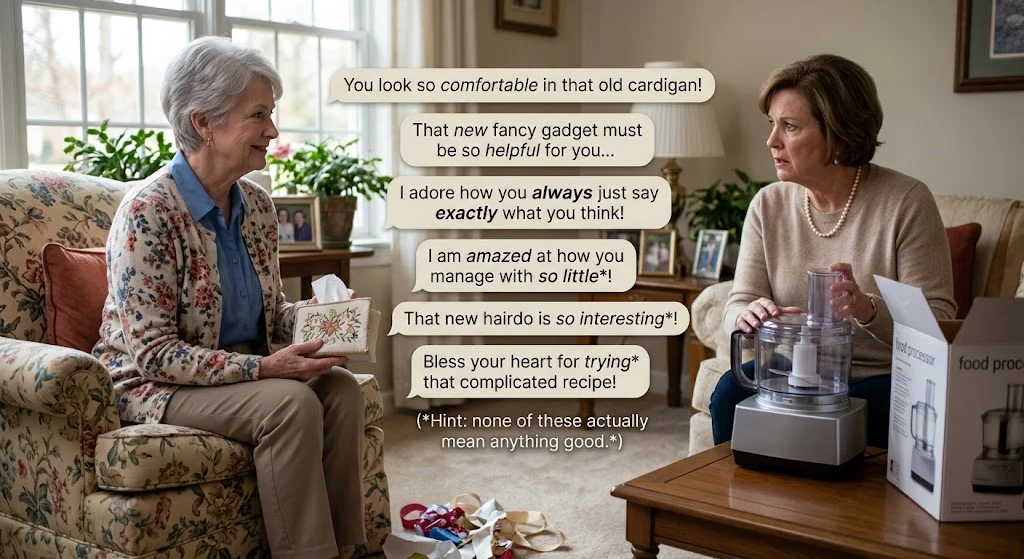
When a Compliment Doesn’t Feel Like a Compliment
Have you ever received a compliment that sounded sweet, but somehow left you thinking, “Wait… was that actually an insult?” Welcome to the wonderfully confusing world of passive-aggressive compliments.
These phrases are especially interesting because they often wear a friendly disguise. Someone smiles, says something that sounds positive, and walks away while you stand there wondering whether you were praised, roasted, or professionally insulted.
One of the most famous examples is “bless your heart.” Depending on the speaker, relationship, tone, and situation, it can express genuine sympathy—or quietly communicate, “You poor, clueless thing.”
That double meaning makes passive-aggressive compliments perfect for conversations where sarcasm, humor, and subtle shade collide.
In this guide, we’ll explore what passive-aggressive compliments mean, why people use them, how “bless your heart” can change meaning, and dozens of examples you can recognize or use when the situation calls for a little playful sass.MORE information:-Things to say when someone calls you extra .
Quick Summary Box
What are passive-aggressive compliments?
Passive-aggressive compliments are statements that appear positive but contain subtle criticism, sarcasm, or hidden disapproval.What does “bless your heart” mean?
It can be a sincere expression of sympathy or affection, but in certain contexts it can also be a polite-sounding way to express disbelief, criticism, or amusement.Example: “Bless your heart, you really thought that was going to work.”
Best response: Match the tone. You can respond with humor, confidence, or a calm “I’ll take that as a compliment.”
What Is a Passive-Aggressive Compliment?
A passive-aggressive compliment is a statement that technically sounds positive while quietly carrying a negative message.
The speaker does not directly say, “I dislike your outfit.” Instead, they might say, “Wow, you’re really brave for wearing that.”
The words are positive. The implication is not.
This communication style often relies on tone, context, facial expression, timing, and shared knowledge. The same sentence can be completely sincere in one situation and hilariously shady in another.
Here are some common examples:
- “You’re surprisingly good at this.”
- “That outfit is certainly memorable.”
- “I love how confident you are.”
- “You really don’t care what people think, do you?”
- “That’s definitely one way to do it.”
- “You look great for someone who just woke up.”
- “I admire your confidence.”
- “You always have such interesting ideas.”
- “Bless your heart.”
- “You’re much more organized than I expected.”
- “That color actually works on you.”
- “You make casual look very casual.”
The psychology behind these phrases is simple: indirect criticism can feel safer than direct confrontation.
Why Do People Give Backhanded Compliments?
People use backhanded compliments for many reasons. Sometimes it is intentional sarcasm. Sometimes it comes from insecurity, competitiveness, jealousy, social awkwardness, or simply a particular sense of humor.
A person may want to criticize without openly starting an argument.
For example, saying “Your presentation was interesting” is much less confrontational than saying “Your presentation was confusing.”
That ambiguity gives the speaker plausible deniability.
Here are 10 common motivations:
- To tease someone.
- To express jealousy.
- To hide criticism.
- To establish social dominance.
- To avoid direct confrontation.
- To make a joke.
- To sound clever.
- To express frustration indirectly.
- To test someone’s confidence.
- To create playful tension.
- To disguise an insult.
- To get a reaction.
In friendly relationships, this can be harmless banter. In professional or emotionally sensitive situations, however, repeated passive-aggressive remarks can become exhausting.
When “Bless Your Heart” Means Something Else
“Bless your heart” is one of those expressions whose meaning depends heavily on context.
Someone might genuinely say it after hearing that you had a difficult day:
“You’ve been working all week and still have to work Saturday? Bless your heart.”
That is sympathetic.
But imagine someone hears your questionable business idea and responds:
“Oh, bless your heart. You really think that’s going to work?”
Suddenly, the phrase has a completely different flavor.
It can imply:
- “You poor thing.”
- “You don’t understand.”
- “That was an adorable attempt.”
- “You really believe that?”
- “I disagree, but I’m being polite.”
- “You are being a little clueless.”
- “That was optimistic.”
- “I’m trying not to laugh.”
- “You mean well.”
- “I have no idea how to explain this to you.”
- “That was cute.”
- “Good luck with that.”
The important point is that “bless your heart” is not automatically an insult. Tone and context determine whether it is affectionate, sympathetic, humorous, or passive-aggressive.
10 Passive-Aggressive “Bless Your Heart” Examples
If you are looking for examples of when the phrase carries hidden shade, these illustrate the difference.
- “Bless your heart, you really tried.”
- “Oh, bless your heart. You thought that was the answer?”
- “Bless your heart, confidence is certainly your strength.”
- “Well, bless your heart for being so optimistic.”
- “Bless your heart, you always say exactly what you’re thinking.”
- “You wore that outfit confidently. Bless your heart.”
- “Bless your heart, you really committed to that decision.”
- “Oh honey, bless your heart.”
- “Bless your heart, you gave it your best.”
- “You really believe that? Bless your heart.”
- “Bless your heart, you’re adorable when you’re wrong.”
- “Well, bless your heart. That explains a lot.”
The phrase becomes especially sarcastic when paired with an obviously contradictory statement.
For example:
“Bless your heart, you’re incredibly patient for someone who has complained about this for three hours.”
That is technically sweet. Emotionally? Absolutely not.
Funny Passive-Aggressive Compliments for Friends
With close friends, passive-aggressive compliments can become a form of affectionate comedy.
The key is knowing your audience. If your friend understands your humor, a playful roast can make everyone laugh. If they do not, you may accidentally create a social emergency.
Try these:
- “You’re glowing today. Did you finally sleep?”
- “I love your confidence. It’s inspiring.”
- “You always know how to make an entrance.”
- “You’re actually early. I’m impressed.”
- “Look at you making responsible decisions.”
- “That idea is surprisingly creative.”
- “You cleaned your room? Character development!”
- “You look suspiciously put together today.”
- “I’m proud of you for reading the instructions.”
- “You’re really committed to being yourself.”
- “Honestly, I admire your ability to ignore common sense.”
- “You make chaos look effortless.”
These work best when delivered with a smile and an obviously playful tone.
Southern-Style “Bless Your Heart” Meanings
The phrase is strongly associated with Southern American speech, but its interpretation varies greatly from person to person.
In one conversation, “bless your heart” may be deeply affectionate. In another, it may be a soft verbal eyebrow raise.
Consider these possible meanings:
- Genuine sympathy.
- Affection.
- Concern.
- Polite disagreement.
- Gentle teasing.
- Mild criticism.
- Sarcasm.
- Amusement.
- Condescension.
- Disbelief.
- Exasperation.
- A humorous way to end an argument.
For example, if someone says:
“I accidentally locked myself out again.”
A genuine response might be:
“Oh no, bless your heart.”
But if someone says:
“I’m going to finish this entire project five minutes before the deadline.”
A sarcastic:
“Bless your heart.”
might translate to:
“You are incredibly optimistic.”
That is where context becomes everything.
Passive-Aggressive Compliments About Appearance
Appearance-related compliments are one of the easiest places for backhanded praise to appear.
Instead of directly criticizing someone’s clothing, hairstyle, or makeup, the speaker hides the opinion inside a compliment.
Examples include:
- “That hairstyle is definitely different.”
- “You look surprisingly elegant.”
- “I love how adventurous your fashion is.”
- “That outfit takes confidence.”
- “You really know how to stand out.”
- “That color is certainly bold.”
- “I could never pull that off.”
- “You look great from this angle.”
- “Your makeup is very dramatic today.”
- “You’re brave for wearing that.”
- “That’s a very unique look.”
- “Nobody can say you’re afraid of attention.”
The safest interpretation is not always the most negative one. Sometimes people genuinely mean what they say.
Passive-Aggressive Compliments at Work
Workplace compliments can be especially tricky because sarcasm can create unnecessary tension.
For example:
“Wow, you actually finished early.”
The word “actually” changes the emotional meaning.
Other examples include:
- “You’re surprisingly efficient today.”
- “That was much faster than expected.”
- “I didn’t know you had that skill.”
- “You managed to keep the meeting short.”
- “That presentation was certainly memorable.”
- “You really went above and beyond.”
- “I admire how confident you were with that answer.”
- “That’s an interesting approach.”
- “You certainly have a unique management style.”
- “I appreciate your enthusiasm.”
- “You made a bold choice there.”
- “Well, that was certainly one solution.”
In professional settings, it is usually better to avoid deliberately passive-aggressive language. Humor can easily be misunderstood in email, meetings, or group chats.
Clever Responses to Passive-Aggressive Compliments
When someone gives you a backhanded compliment, you do not have to become defensive.
Sometimes the best response is to accept the compliment literally.
Try these clever responses:
- “Thank you! I’ll take that as a compliment.”
- “Aww, I appreciate that.”
- “I’m choosing to focus on the positive.”
- “Thanks. I worked hard on that.”
- “I knew you’d eventually notice.”
- “That’s exactly what I was going for.”
- “I’m glad my confidence is showing.”
- “Thank you for your support.”
- “I’ll put that on my résumé.”
- “You’re too kind.”
- “I’ll pretend there wasn’t a second meaning.”
- “Bless your heart too.”
That last response is especially fun when someone uses “bless your heart” sarcastically.
Savage but Funny Responses to “Bless Your Heart”
If the conversation is clearly playful, you can return the energy without becoming genuinely rude.
Here are some witty comebacks:
- “And yours too, sweetheart.”
- “I accept your concern and your shade.”
- “That sounded suspiciously sarcastic.”
- “Careful, I speak fluent sarcasm.”
- “Was that a blessing or a warning?”
- “I’ll add that to my collection of compliments.”
- “Bless your vocabulary.”
- “Thank you for your emotional support.”
- “That was almost sweet.”
- “I feel blessed and roasted.”
- “Was there a compliment hiding in there?”
- “I’ll choose the version where you meant well.”
These work particularly well among friends because they acknowledge the hidden meaning without escalating the interaction.
How to Tell If “Bless Your Heart” Is an Insult
Wondering whether someone actually complimented you?
Look beyond the words.
Pay attention to:
- Their tone of voice.
- Facial expression.
- Timing.
- What happened immediately before.
- Your relationship with the person.
- Whether they laughed afterward.
- Whether the phrase followed criticism.
- Their usual communication style.
- Whether the comment made sense literally.
- Whether they emphasized particular words.
- Whether other people reacted.
- Whether the statement contradicts the situation.
For example, “Bless your heart” after someone shares sad news is probably sympathetic.
“Bless your heart” after someone announces an obviously terrible decision may be sarcastic.
The phrase itself is not enough to determine intent.
The Psychology Behind Backhanded Compliments
Why does indirect criticism exist at all?
Humans often want to communicate negative feelings while avoiding the social consequences of saying them directly.
A backhanded compliment creates ambiguity.
The speaker can say:
“I was complimenting you!”
if challenged.
Meanwhile, the listener may still understand the hidden criticism.
This is sometimes called plausible deniability in everyday communication.
The emotional effect can be confusing because the recipient has to interpret two messages at once: the literal message and the implied message.
That is why phrases like these can feel strangely uncomfortable:
- “You’re better than I expected.”
- “You look good today.”
- “You finally made a good decision.”
- “That was surprisingly intelligent.”
- “You’re not as difficult as people say.”
- “You actually handled that well.”
- “I like you when you’re quiet.”
- “You clean up nicely.”
- “You’re much nicer than I thought.”
- “I’m impressed you figured that out.”
- “You’re brave to say that.”
- “Bless your heart.”
The hidden message is often what makes the compliment feel like an insult.
When Passive-Aggressive Compliments Are Funny—and When They Aren’t
Not every sarcastic compliment is harmless.
The difference usually comes down to relationship, intention, frequency, and emotional impact.
Among close friends, “You actually remembered the password?” can be hilarious.
From a manager, “You finally met a deadline” can feel insulting.
A useful rule is simple:
If everyone is laughing, it may be banter. If only the speaker is laughing, it may be shade.
Use passive-aggressive humor carefully when:
- You do not know the person well.
- The situation is professional.
- Someone is already upset.
- The topic is sensitive.
- There is a power imbalance.
- Your words could affect someone’s reputation.
Sarcasm is funniest when people understand the joke and feel safe enough to laugh.
How to Respond Without Starting an Argument
Sometimes the strongest response is not a savage comeback.
You can simply refuse to participate in the negativity.
Try:
- “Thanks, I appreciate it.”
- “I’ll take that positively.”
- “Interesting way to phrase that.”
- “Did you mean that as a compliment?”
- “I’m happy with my choice.”
- “I think we see it differently.”
- “No worries.”
- “I know what you mean.”
- “Let’s keep it friendly.”
- “I’m good with it.”
- “Anyway, moving on…”
- “Thanks for your concern.”
These responses remove the emotional reward from passive-aggressive behavior.
If someone wanted a reaction, calm confidence gives them very little to work with.
Related Questions People Ask About “Bless Your Heart”
Is “bless your heart” always an insult?
No. It can express genuine sympathy, affection, concern, or kindness. In certain contexts, however, it can carry sarcasm or subtle criticism.
What does “bless your heart” mean when someone is being sarcastic?
It can mean something like “you poor thing,” “you really don’t understand,” or “that was an adorable attempt.” The exact meaning depends on tone and context.
Is “bless your heart” a Southern insult?
It can be used sarcastically in Southern American English, but it is not inherently an insult. Many people use it sincerely.
What is a backhanded compliment?
A backhanded compliment is a statement that sounds positive but contains an implied criticism.
How do you respond to a passive-aggressive compliment?
You can respond humorously, calmly accept the compliment, ask for clarification, or simply ignore the hidden criticism.
What is a funny response to “bless your heart”?
Try: “Was that a blessing or a warning?” or “I feel blessed and roasted at the same time.”
Are passive-aggressive compliments rude?
They can be. Context matters. Playful teasing between friends may be harmless, while repeated indirect criticism can become disrespectful.
How can you tell if someone is being passive-aggressive?
Look at tone, context, facial expression, timing, and whether the literal compliment conflicts with the situation.
Passive Aggressive Compliments When “Bless Your Heart” Means Something Else in Everyday Conversations
Sometimes a sentence can sound completely harmless until you hear the tone behind it. That is exactly why passive aggressive compliments when bless your heart means something else is such an interesting topic. The words may look sweet on the surface, but the hidden message can be anything from gentle teasing to a surprisingly sharp insult.
Imagine telling someone, “I finally finished that difficult project,” and hearing, “Oh, bless your heart. You really worked hard on that.” Technically, they complimented your effort. But depending on their expression, pause, and tone, you may immediately wonder whether they just praised you or quietly roasted you.
That uncertainty is what makes passive-aggressive language so entertaining—and sometimes frustrating.
Here are some examples that demonstrate the idea:
- “Bless your heart, you really gave it your best.”
- “You certainly have confidence.”
- “That was an interesting decision.”
- “I admire how optimistic you are.”
- “You really believe that?”
- “Bless your heart, you tried.”
- “That outfit takes courage.”
- “You always have such creative ideas.”
- “I didn’t expect you to finish so quickly.”
- “You clean up nicely.”
- “That is certainly one way to handle it.”
- “Bless your heart, you mean well.”
The real meaning depends on the situation, which is why context matters more than the phrase itself.
Why “Bless Your Heart” Can Sound Like a Compliment and an Insult
The phrase “bless your heart” is fascinating because it can carry multiple emotional meanings. It may express sympathy after someone shares bad news, affection between friends, or sarcasm when someone makes an obviously questionable statement.
That makes it a perfect example of passive aggressive compliments when bless your heart means something else.
Consider these situations.
Genuine sympathy
“You lost your wallet on vacation? Bless your heart.”
Here, the phrase sounds caring.
Friendly teasing
“You forgot your own birthday? Bless your heart.”
Now it is playful.
Sarcasm
“You really thought that plan would work? Bless your heart.”
Here, the speaker may actually mean:
“You are being incredibly optimistic.”
Hidden criticism
“Bless your heart, you always know how to make things complicated.”
That sounds much less like praise.
The same words can therefore communicate completely different messages.
15 Passive Aggressive Compliments When “Bless Your Heart” Is Used Sarcastically
If you’re specifically searching for passive aggressive compliments when bless your heart means something else, these examples show how the phrase can become a subtle roast.
- “Bless your heart, you really thought that was a good idea.”
- “Oh, bless your heart, you tried so hard.”
- “Bless your heart, confidence is definitely not your problem.”
- “You really committed to that outfit. Bless your heart.”
- “Bless your heart, you always find the most complicated solution.”
- “You genuinely believed that? Bless your heart.”
- “Bless your heart, you were so close.”
- “Oh honey, bless your heart for trying.”
- “Bless your heart, you really don’t give up.”
- “You make optimism look effortless. Bless your heart.”
- “Bless your heart, you thought everyone agreed with you.”
- “You certainly have an interesting perspective. Bless your heart.”
- “Bless your heart, that explanation cleared up absolutely nothing.”
- “You really said that with confidence. Bless your heart.”
- “Bless your heart, you meant well.”
These examples work because the phrase creates a polite wrapper around a less-than-polite message.
Backhanded Compliments That Sound Sweet but Aren’t
Another important part of understanding passive aggressive compliments when bless your heart means something else is recognizing backhanded compliments that do not use the phrase at all.
A backhanded compliment often contains an unexpected comparison or qualification.
For example:
“You look great today.”
Sounds positive.
But:
“You look great today—you must have finally gotten some sleep.”
adds a subtle criticism.
Here are more examples:
- “You look surprisingly good today.”
- “You are much nicer than I expected.”
- “I love how little you care what people think.”
- “That hairstyle is definitely bold.”
- “You actually handled that pretty well.”
- “You’re smarter than you look.”
- “I like your confidence.”
- “You’re brave for wearing that.”
- “You really know how to stand out.”
- “That was surprisingly intelligent.”
- “You clean up better than I expected.”
- “You have a very unique sense of style.”
The hidden criticism comes from the part that changes the meaning of the compliment.
Funny “Bless Your Heart” Compliments for Friends
With friends, passive-aggressive compliments can become hilarious when everyone understands the joke.
Suppose your friend arrives forty minutes late and says, “Sorry, traffic was terrible.”
You could say:
“Bless your heart. Time really is just a suggestion to you.”
That is clearly playful if your friendship already includes teasing.
Try these funny variations:
- “Bless your heart, punctuality almost found you.”
- “You look amazing for someone who ignored every alarm.”
- “Bless your heart, you finally remembered.”
- “I love your confidence in making terrible decisions.”
- “You make chaos look surprisingly organized.”
- “Bless your heart, you almost had it.”
- “Your ability to improvise is truly something.”
- “You really make procrastination look professional.”
- “Bless your heart, you tried to be responsible.”
- “I admire your commitment to doing things your own way.”
- “You have such a creative relationship with common sense.”
- “Bless your heart, you remain consistent.”
The goal is playful exaggeration, not genuine humiliation.
Passive Aggressive Compliments About Intelligence
Intelligence is another area where backhanded compliments can become particularly obvious.
Compare:
“That was a smart idea.”
with:
“Wow, that was actually a smart idea.”
The second version suggests the speaker expected the opposite.
Examples include:
- “You actually figured it out.”
- “That was smarter than I expected.”
- “I didn’t know you knew that.”
- “You really surprised me with that answer.”
- “That was almost brilliant.”
- “You made a good point for once.”
- “You caught that quickly.”
- “I’m impressed you noticed.”
- “You understood that better than I thought.”
- “Look at you using logic.”
- “That was unexpectedly clever.”
- “Bless your heart, you really did your research.”
These can be funny among friends but offensive when used seriously.
Passive Aggressive Compliments About Someone’s Style
Fashion is another easy target for disguised criticism because style is subjective.
A person may say something positive while subtly questioning your choices.
Here are 15 examples:
- “That outfit is definitely memorable.”
- “You’re really committed to that look.”
- “That color is very bold.”
- “You certainly know how to get attention.”
- “I could never pull that off.”
- “That’s a very unique outfit.”
- “You’re brave enough to wear that.”
- “I admire your confidence.”
- “That style really suits your personality.”
- “You always choose interesting combinations.”
- “That is certainly a fashion statement.”
- “Bless your heart, you really went for it.”
- “Nobody could accuse you of dressing boring.”
- “You have such an adventurous style.”
- “That outfit definitely has a personality.”
Notice how none of these phrases is automatically insulting. The meaning changes depending on whether the speaker sounds genuinely impressed or suspiciously amused.
Passive Aggressive Compliments at Work
Professional environments require extra caution.
A sarcastic comment that seems hilarious between friends can sound disrespectful at work.
For example:
“You finally finished it. Bless your heart.”
That may create tension rather than laughter.
Some workplace-style passive-aggressive compliments include:
- “You managed to finish ahead of schedule.”
- “That was surprisingly efficient.”
- “I didn’t expect you to solve it that quickly.”
- “That’s an interesting approach.”
- “You certainly took ownership of that.”
- “You have a very confident presentation style.”
- “That was a bold recommendation.”
- “You really stuck to your idea.”
- “I admire your persistence.”
- “You certainly made your position clear.”
- “That was one way to approach the problem.”
- “You kept the meeting interesting.”
- “You certainly had a lot to say.”
- “I appreciate your enthusiasm.”
- “Bless your heart, you really committed to that strategy.”
If you’re on the receiving end, don’t automatically assume the speaker intended an insult. Professional communication can sometimes sound awkward without being malicious.
How to Respond to “Bless Your Heart” Without Getting Defensive
If someone uses “bless your heart” sarcastically, you have several options.
The strongest response is often calm confidence.
Try:
- “Thank you. I’ll take that positively.”
- “Was that a blessing or a roast?”
- “I appreciate the blessing.”
- “I feel blessed already.”
- “I’ll assume you meant that kindly.”
- “That sounded suspiciously sarcastic.”
- “Bless yours too.”
- “I know that tone.”
- “You almost made that sound sweet.”
- “I’ll happily accept the compliment.”
- “That’s one way to phrase it.”
- “I’m choosing to hear the nice part.”
These responses work because they do not give the other person an easy emotional reaction.
Savage Responses to Passive Aggressive Compliments
Sometimes the conversation is clearly playful and you want something sharper.
Here are some witty comebacks:
- “Thanks. Your subtlety is inspiring.”
- “I appreciate the compliment hidden inside the insult.”
- “That was almost believable.”
- “You practiced that one, didn’t you?”
- “I’ll treasure your carefully disguised approval.”
- “Was there supposed to be a compliment in there?”
- “You’re getting better at pretending to be nice.”
- “That shade looks good on you.”
- “Bless your heart right back.”
- “I see what you did there.”
- “Nice attempt at being subtle.”
- “I heard the compliment hiding behind the sarcasm.”
- “Your concern has been officially received.”
- “I’ll add that to my collection of questionable compliments.”
- “That was impressively passive-aggressive.”
Use these only when the relationship and context make sarcasm appropriate.
Passive Aggressive Compliments When “Bless Your Heart” Means Jealousy
Sometimes a backhanded compliment comes from comparison or insecurity.
Someone may not openly say, “I’m jealous,” but their wording can reveal discomfort.
For example:
“Wow, you actually got the promotion.”
The word “actually” changes the emotional tone.
Other examples include:
- “You’re lucky they noticed you.”
- “That outfit must have cost a lot.”
- “I didn’t know you were going for that look.”
- “You really landed that opportunity.”
- “Must be nice.”
- “You always seem to get what you want.”
- “I guess things work out for some people.”
- “You really didn’t have to work that hard for it.”
- “Bless your heart, everything seems to work out for you.”
- “You certainly know how to get noticed.”
- “I’m surprised they picked you.”
- “Good for you. Seriously.”
Again, tone determines whether these are sincere congratulations or subtle resentment.
How to Tell a Genuine Compliment From a Backhanded One
The easiest method is to examine the complete message rather than one phrase.
Ask yourself:
Does the statement make sense as a sincere compliment?
If someone says:
“You handled that difficult situation really well.”
there is little hidden criticism.
But:
“You handled that difficult situation surprisingly well.”
contains a subtle expectation that you would fail.
Look for words such as:
- actually
- surprisingly
- finally
- for once
- even
- at least
- somehow
- brave
- interesting
- unique
- certainly
- bless your heart
These words are not inherently negative. They simply deserve attention when paired with unusual tone or context.
Why Tone Matters More Than the Words
A major reason passive aggressive compliments when bless your heart means something else can be difficult to interpret is that written language removes many conversational clues.
Someone can type:
“Bless your heart 😂”
and mean it as a joke.
Another person might write:
“Bless your heart.”
and intend something much colder.
In face-to-face conversation, tone, facial expression, gestures, and timing provide additional information.
Online, readers have to rely on punctuation, emojis, previous conversations, and relationship history.
That is why sarcasm can cause misunderstandings in:
- Text messages
- Social media comments
- Emails
- Group chats
- Workplace messaging
- Dating conversations
- Online communities
When the tone is unclear, asking a simple question can save a lot of confusion:
“Wait, did you mean that sincerely?”
Passive Aggressive Compliments in Dating and Relationships
Dating conversations can contain plenty of playful teasing, but there is a fine line between flirtation and genuine criticism.
For example:
“You’re actually cute when you’re trying to be serious.”
That could be flirtatious.
But:
“You’re cute when you’re quiet.”
may feel insulting depending on the relationship.
Other examples include:
- “You clean up nicely.”
- “You’re surprisingly romantic.”
- “I didn’t know you had that side.”
- “You actually remembered.”
- “Look at you being thoughtful.”
- “You’re adorable when you’re jealous.”
- “You really tried to impress me.”
- “That was almost smooth.”
- “You’re confident, I’ll give you that.”
- “Bless your heart, you really thought I’d say yes.”
- “You’re cute when you’re confused.”
- “I admire your persistence.”
The same phrase can be flirtatious in one relationship and disrespectful in another.
How to Turn a Passive Aggressive Compliment Into Humor
One of the easiest ways to handle subtle shade is to exaggerate it.
Someone says:
“You actually look nice today.”
Instead of becoming defensive, say:
“Thank you. I’ve been waiting years for your approval.”
Someone says:
“Bless your heart.”
You can answer:
“Finally, the blessing I’ve been waiting for.”
Someone says:
“That’s an interesting choice.”
You can say:
“Thank you. I worked hard to confuse everyone.”
This approach transforms awkwardness into comedy.
Here are more playful responses:
- “Thank you, I try to keep expectations low.”
- “I’m glad my work is finally being recognized.”
- “I knew you’d eventually come around.”
- “Your approval means absolutely everything.”
- “I’ll frame that compliment.”
- “I’ll pretend there wasn’t a hidden insult.”
- “That’s going straight into my motivational quotes.”
- “I’m touched by your enthusiasm.”
- “I appreciate your carefully disguised kindness.”
- “You almost sounded sincere.”
- “Blessings received.”
- “I accept your shade with gratitude.”
When You Should Not Use Passive-Aggressive Compliments
Although sarcastic compliments can be entertaining, there are situations where they are better avoided.
Do not use them when:
- Someone is grieving.
- Someone is genuinely struggling.
- You are dealing with a serious conflict.
- You are speaking to a customer.
- You are addressing a sensitive workplace issue.
- The other person does not understand sarcasm.
- There is a major power imbalance.
- The topic involves someone’s appearance or insecurity.
- You know the person is emotionally upset.
- You are trying to repair a relationship.
- Your words could affect someone’s reputation.
- The joke would embarrass someone publicly.
Humor should make communication easier, not create unnecessary emotional damage.
Frequently Asked Questions About Passive Aggressive Compliments
What does “bless your heart” mean when it is passive-aggressive?
It can imply “you poor thing,” “you don’t understand,” “that was a cute attempt,” or “I disagree with you.” Context and tone determine the exact meaning.
Is “bless your heart” always sarcastic?
No. It can be completely sincere. Many people use it to show sympathy, affection, concern, or kindness.
What is the difference between a compliment and a backhanded compliment?
A normal compliment communicates positive approval. A backhanded compliment sounds positive but contains an implied criticism or negative comparison.
What are some passive-aggressive compliments?
Examples include “You actually look good today,” “You’re surprisingly smart,” “That outfit takes confidence,” and “Bless your heart.”
What is a funny response to a backhanded compliment?
Try, “Thanks, I’ll take that as a compliment,” “Was that a compliment or a roast?” or “I heard the nice part.”
How do you respond to “bless your heart” sarcastically?
You can say, “Was that a blessing or a warning?” “Bless yours too,” or “I feel blessed and roasted at the same time.”
Why do people use backhanded compliments?
They may use them to tease, criticize indirectly, express insecurity, compete socially, or avoid direct confrontation.
Can passive-aggressive compliments be playful?
Absolutely. Among close friends, they can be a normal part of teasing and banter. The key is mutual understanding and respect.
Understanding the Hidden Message Behind Sweet-Sounding Words
By now, it should be clear that passive aggressive compliments when bless your heart means something else are rarely about the literal words alone. The real message often lives underneath the sentence. A person may smile, use a pleasant voice, and choose words that appear complimentary, yet the overall situation tells you something different.
This is what makes backhanded compliments so interesting. They operate on two levels. There is the surface meaning, which sounds positive, and there is the implied meaning, which may contain criticism, disbelief, sarcasm, or playful teasing. When someone says, “You are certainly confident,” they may genuinely admire your confidence—or they may be politely wondering why you have so much of it.
The phrase “bless your heart” takes this ambiguity even further. It can communicate sympathy, affection, amusement, or subtle shade depending on the speaker and situation. That is why passive aggressive compliments when bless your heart means something else are best understood through context rather than through a dictionary definition alone.
If someone says it after hearing that you had a difficult day, the phrase may be compassionate. If someone says it after you make an obviously questionable decision, the same phrase can sound like a tiny verbal eye-roll.
How Context Changes the Meaning
One of the biggest lessons behind passive aggressive compliments when bless your heart means something else is that context can completely transform a phrase.
Imagine someone says, “You really have confidence.”
If you just won an award, that could be sincere praise. If you just made a wildly incorrect statement in front of everyone, it could be sarcasm.
The same thing happens with “bless your heart.” Context tells the listener whether the speaker is offering sympathy or quietly making fun of the situation.
A sincere version might sound like, “You have been through so much lately. Bless your heart.” A sarcastic version might be, “You thought that was going to work? Bless your heart.”
The difference is not the phrase. The difference is the emotional situation surrounding it.
This is why passive aggressive compliments when bless your heart means something else can be difficult to interpret in text messages. Without facial expressions or vocal tone, readers have fewer clues.
Consider phrases such as “Good for you,” “Interesting choice,” “You’re brave,” “That’s certainly different,” “You really tried,” “You’re confident,” “That’s one way to do it,” “You look surprisingly good,” “You finally figured it out,” and “Bless your heart.” Any of them could be sincere or sarcastic.
The Role of Tone in Backhanded Compliments
Tone is one of the strongest clues when interpreting passive aggressive compliments when bless your heart means something else. Two people can say exactly the same sentence and create completely different emotional reactions.
A warm “Bless your heart” may sound comforting. A slow, exaggerated “Bless your heart” may sound like the speaker is trying not to laugh.
This is particularly important with sarcastic compliments. Words like “actually,” “finally,” “surprisingly,” “certainly,” and “for once” can subtly alter a sentence.
“You did well” is straightforward.
“You actually did well” introduces doubt.
“You finally did well” introduces criticism.
“You surprisingly did well” suggests low expectations.
That small difference is the foundation of many backhanded compliments.
When you hear passive aggressive compliments when bless your heart means something else, listen for emphasis and pauses. Someone who sincerely compliments you usually does not need exaggerated delivery. Someone being sarcastic may deliberately emphasize particular words.
When “Bless Your Heart” Is Actually Affectionate
Not every example of passive aggressive compliments when bless your heart means something else should be interpreted negatively. Sometimes the phrase is genuinely affectionate.
A family member might say, “Bless your heart,” after hearing about a stressful experience. A friend might say it when you make an innocent mistake. A caring person might use it simply because it is part of their everyday vocabulary.
For example, imagine someone says, “I spent three hours looking for my glasses before realizing they were on my head.”
A friend might laugh and say, “Oh, bless your heart.”
That does not necessarily mean, “You are stupid.” It can simply mean, “You poor, funny person.”
This distinction matters because constantly assuming negative intent can create unnecessary conflict.
If someone regularly communicates warmly with you, gives genuine support, and occasionally says “bless your heart,” there may be no hidden insult at all.
When “Bless Your Heart” Becomes a Quiet Roast
On the other hand, passive aggressive compliments when bless your heart means something else become obvious when the phrase follows an unrealistic claim, poor decision, or exaggerated opinion.
Imagine someone confidently announces, “I’m going to finish this huge project tonight, even though I haven’t started.”
Their friend responds:
“Bless your heart.”
The phrase may actually mean, “You are being incredibly optimistic.”
Another person says, “I definitely don’t need directions. I know exactly where I’m going,” and then gets completely lost.
A friend might respond, “Bless your heart.”
Again, the hidden meaning is not cruel. It is playful.
That is why passive aggressive compliments when bless your heart means something else can sometimes function as affectionate humor. Friends often develop shared language where a phrase becomes shorthand for an entire joke.
Clever Responses That Keep Things Light
If you recognize the hidden meaning but do not want to create tension, humor can be an excellent response.
When someone says, “Bless your heart,” you could answer, “Was that a blessing or a warning?”
If they say, “You’re certainly confident,” respond with, “Thank you. I’ve been practicing.”
If someone says, “That’s an interesting choice,” you could say, “Interesting is exactly what I was going for.”
Other playful responses include, “I’ll take that as approval,” “I appreciate the support,” “Your concern has been noted,” “That sounded almost sincere,” “I feel blessed already,” “Bless your heart right back,” “I heard the compliment hiding in there,” “I accept the shade,” “Thanks for noticing,” and “I’ll pretend there wasn’t a second meaning.”
These responses work because they acknowledge the humor without becoming defensive.
The goal of handling passive aggressive compliments when bless your heart means something else is not always to win the conversation. Sometimes the smartest move is to show that you are comfortable enough not to be rattled.
Responses When You Want to Be More Direct
Humor is not always appropriate. If someone repeatedly gives you backhanded compliments, you may eventually want to address the behavior.
A calm question can reveal the speaker’s intention.
You might say, “What do you mean by that?”
Or, “Was that supposed to be a compliment?”
Another option is, “I’m not sure how to take that.”
You can also say, “If there’s something you want to tell me, you can say it directly.”
These responses are particularly useful when passive aggressive compliments when bless your heart means something else are happening in a workplace, family disagreement, or difficult relationship.
Direct communication removes the ambiguity that passive-aggressive language depends on.
Instead of spending twenty minutes wondering what someone meant, you give them an opportunity to explain themselves.
Why Backhanded Compliments Can Feel So Confusing
There is a psychological reason people often feel uncomfortable after receiving a backhanded compliment.
The literal message and implied message conflict.
Your brain hears, “You look great,” but the speaker adds, “for once.”
Now you have two messages:
“You look great.”
“You usually don’t.”
That contradiction creates confusion.
The same thing happens with phrases such as “You’re surprisingly smart,” “You actually did well,” “You clean up nicely,” “You’re much nicer than I expected,” “That outfit takes confidence,” “You really don’t care what people think,” “You finally made a good decision,” “That was almost brilliant,” “You’re brave for saying that,” and “Bless your heart.”
The positive words do not completely cancel the negative implication.
This is one reason passive aggressive compliments when bless your heart means something else can have more emotional impact than an obvious insult. An obvious insult is easy to identify. A backhanded compliment forces you to decode what happened.
Passive-Aggressive Compliments in Social Situations
Social gatherings provide plenty of opportunities for subtle compliments.
Someone might comment on your clothes, career, relationship, home, personality, or lifestyle.
“You’ve really changed.”
“You look different.”
“You’re brave for wearing that.”
“You’re surprisingly outgoing.”
“You always know how to make an entrance.”
“You seem happy.”
“You’re certainly confident.”
“You really committed to that look.”
“You have such an interesting personality.”
“Bless your heart.”
Each phrase could be harmless. Each could also carry an additional meaning depending on the situation.
For example, “You seem happy” can be genuinely sweet. But if someone says it after you recently achieved something they wanted, it may sound strangely cold.
The lesson from passive aggressive compliments when bless your heart means something else is simple: never interpret a phrase completely outside its context.
When Sarcasm Becomes Too Much
There is a difference between playful sarcasm and constant passive aggression.
A friend saying, “Bless your heart,” after you forget your keys is probably harmless.
Someone repeatedly criticizing your intelligence, appearance, choices, or abilities through disguised compliments is different.
If every interaction contains a hidden jab, the humor may no longer be playful.
For example, occasional teasing such as “You actually remembered this time” can be funny between close friends. But constantly hearing “You actually look nice today,” “You surprisingly understand this,” and “You finally made a good decision” can become emotionally tiring.
Healthy humor should leave both people feeling comfortable.
If only one person is laughing while the other person repeatedly feels embarrassed, the communication needs to change.
How to Recognize the Difference Between Teasing and Insults
Understanding passive aggressive compliments when bless your heart means something else also means learning to distinguish playful teasing from genuine hostility.
Ask yourself whether the relationship already includes mutual joking.
If both people tease each other and both can laugh, the comment may be playful.
If one person consistently makes the jokes while the other person is always the target, there may be a problem.
Consider these questions:
Does the person respect you in other conversations?
Do they apologize when they cross a line?
Do they laugh with you or only at you?
Do they compliment you sincerely?
Do they make similar jokes about themselves?
Do you feel comfortable responding honestly?
If the answer to most of these questions is yes, the comment may simply be banter.
If the answer is consistently no, the “compliment” may be a disguised criticism.
How to Use “Bless Your Heart” Without Being Rude
If you want to use the phrase yourself, context is important.
Use it sincerely when someone is struggling. Use it playfully with people who understand your humor. Avoid using it sarcastically when someone is vulnerable or when the situation is serious.
For example:
“Your flight was canceled and your luggage got lost? Bless your heart.”
That sounds sympathetic.
“You forgot your password again? Bless your heart.”
That could be playful between friends.
“You really think you know more than everyone here? Bless your heart.”
That is much more likely to sound condescending.
The safest approach is to make your intention obvious when necessary.
A smile, laugh, or affectionate tone can communicate playful teasing. A cold expression can make the same words sound like an insult.
Passive Aggressive Compliments in Text Messages
Texting makes passive aggressive compliments when bless your heart means something else even more complicated.
Without vocal tone, a phrase like “Wow, good for you” can be interpreted in several ways.
An emoji can help, but it is not a perfect solution.
For example:
“Bless your heart 😂”
looks playful.
“Bless your heart.”
looks more ambiguous.
“Bless your heart ❤️”
may appear affectionate.
But even punctuation can be misleading because people have different texting styles.
If someone sends a message that feels passive-aggressive, do not immediately assume the worst. Look at the broader conversation.
You can also ask:
“Wait, are you teasing me?”
That simple question often solves the problem instantly.
Funny Examples You Can Use With Close Friends
If your friendship is built around playful sarcasm, these examples can work well.
“Bless your heart, you almost made a responsible decision.”
“Look at you, pretending to have a plan.”
“You’re surprisingly functional today.”
“I admire your commitment to questionable choices.”
“You really brought confidence to that mistake.”
“Bless your heart, you thought nobody noticed.”
“You make being late look like a lifestyle.”
“That was almost a sensible idea.”
“You’re really keeping expectations interesting.”
“Bless your heart, you tried.”
“You’re nothing if not consistent.”
“I respect your dedication to chaos.”
The humor comes from exaggeration rather than cruelty.
The Best Way to Handle a Backhanded Compliment
When you receive a questionable compliment, you have three basic choices: accept it, challenge it, or joke about it.
Accepting it might sound like, “Thanks, I appreciate that.”
Challenging it might sound like, “What exactly do you mean?”
Joking about it might sound like, “I’m choosing to hear the nice part.”
There is no single perfect response.
The right answer depends on your relationship with the speaker and the seriousness of the situation.
If the comment is harmless, humor is usually enough.
If the comment is repeated or disrespectful, direct communication is healthier.
If the person is clearly trying to provoke you, staying calm may be the most effective response.
SEO-Friendly Takeaway: What Does “Bless Your Heart” Really Mean?
So, what does passive aggressive compliments when bless your heart means something else actually tell us about everyday communication?
It tells us that language is flexible.
“Bless your heart” can mean sympathy, affection, teasing, disbelief, or sarcasm.
A backhanded compliment can sound positive while communicating criticism.
And a witty response can turn an awkward interaction into a funny moment.
If you are wondering whether someone used “bless your heart” sincerely, focus on tone, context, relationship, and timing rather than the phrase alone.
If you are wondering how to respond, choose confidence over defensiveness.
And if you are wondering whether you should use passive-aggressive compliments yourself, remember that sarcasm works best when everyone understands the joke.
Related Search Questions
People searching for passive aggressive compliments when bless your heart means something else often have closely related questions about sarcasm, Southern expressions, and hidden insults.
What does bless your heart really mean?
It can mean genuine sympathy or affection, but it may also be used sarcastically to suggest that someone is naïve, mistaken, or amusingly unaware.
Is bless your heart a compliment or an insult?
It can be either. The meaning depends on tone, context, and the relationship between the speakers.
What is an example of a passive-aggressive compliment?
“You actually look good today” is a classic example because the word “actually” can imply that the speaker normally expects you not to look good.
What is a backhanded compliment?
It is praise that contains a subtle criticism or negative comparison.
How do you respond to someone saying bless your heart?
You can respond playfully with “Was that a blessing or a warning?” or calmly say, “Thanks, I’ll take that as a compliment.”
Why do people give passive-aggressive compliments?
They may want to criticize indirectly, make a joke, express insecurity, compete socially, or avoid direct confrontation.
Final Thoughts: Read Between the Lines
The world of passive aggressive compliments when bless your heart means something else is ultimately a lesson in reading between the lines.
A compliment is not always simply a compliment. A phrase that sounds sweet can contain a joke, a criticism, a warning, or genuine affection. The difference often comes down to context.
“Bless your heart” remains one of the best examples because it can move effortlessly from sincere sympathy to playful sarcasm.
The trick is not to become suspicious of every nice thing someone says. Instead, pay attention to patterns. Listen to tone. Consider the relationship. Watch what happens before and after the comment.
If the person genuinely cares about you, give them the benefit of the doubt.
If they are teasing you, laugh when it is funny.
If they are repeatedly insulting you through disguised compliments, you are allowed to set a boundary.
And if you want to respond with humor, remember the golden rule of witty comebacks: confidence works better than anger.
Sometimes a simple “Thank you, I’ll take that as a compliment” is enough to turn a passive-aggressive moment into a harmless one.
After all, the best way to deal with subtle shade is not always to throw more shade. Sometimes, it is simply to smile, understand exactly what happened, and move on with your day.
That is the real secret behind passive aggressive compliments when bless your heart means something else: the words may be indirect, but your response does not have to be.
Final Thoughts: Read Between the Lines
The world of passive-aggressive compliments is ultimately a lesson in reading between the lines. A compliment is not always simply a compliment. A phrase that sounds sweet can contain a joke, criticism, warning, or genuine affection. The difference often comes down to context, tone, and the relationship between the speakers.
“Bless your heart” remains one of the best examples because it can move effortlessly from sincere sympathy to playful sarcasm. The smartest response is to listen carefully, consider the situation, and avoid assuming negative intent too quickly.
If someone is teasing you, laugh when it is genuinely funny. If they are repeatedly insulting you through disguised compliments, you are allowed to set a boundary. And if you want to respond with humor, confidence usually works better than anger.
In the end, good communication is about understanding the language behind the words as well as the words themselves. Sometimes the sweetest-looking sentence carries a little shade—and knowing how to recognize it can help you respond with confidence, humor, and grace.
1 thought on “Passive-Aggressive Compliments: When “Bless Your Heart” Means Something Else 😏 | 2026 Guide”