
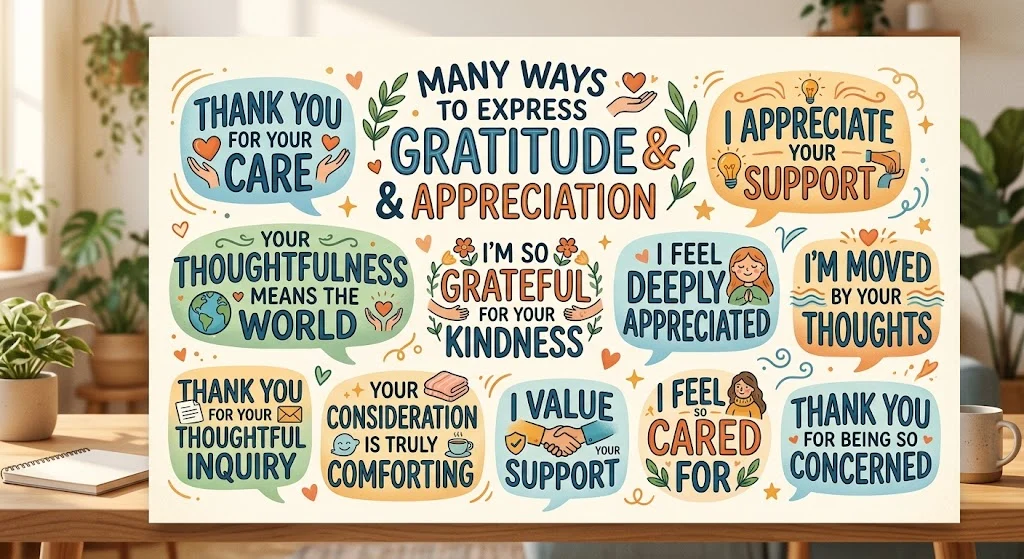
Sometimes, someone says, “I’m worried about you,” “I heard you weren’t feeling well,” or simply, “I’m concerned about what’s happening.” Your first instinct may be to say, “Thank you for your concern.” It is polite, sincere, and perfectly acceptable—but it can also sound a little formal or repetitive.
That is where having other ways to say thank you for your concern becomes useful.
The best response depends on who is speaking, why they are concerned, and how you actually feel about their attention. A close friend might deserve a warm “Thanks for checking in on me,” while a coworker may call for something more professional such as “I appreciate you reaching out.” If someone has gone out of their way to support you, you may want your response to sound especially heartfelt.
In this guide, you’ll find natural, polite, professional, casual, heartfelt, short, and text-friendly alternatives. Whether you’re replying to a friend, family member, colleague, boss, or someone who simply wanted to make sure you were okay, there’s a response here that fits the moment.more clicks:-Best responses to happy Hanukkah or Perfect responses to hope you have fun .
Quick Summary Box
Other ways to say “thank you for your concern” include:
- “I really appreciate you checking in.”
- “Thanks for looking out for me.”
- “I appreciate you reaching out.”
- “Thanks for caring.”
- “It means a lot that you asked.”
- “Thank you for checking on me.”
- “I’m grateful for your thoughtfulness.”
- “Thanks for being there.”
- “I appreciate your kindness.”
- “It’s really thoughtful of you to ask.”
- “Thanks for keeping me in mind.”
- “I’m glad you checked in.”
Best all-purpose option:
“I really appreciate you checking in on me.”
It sounds natural, warm, and sincere without being overly formal.
1. Why Say “Thank You for Your Concern” Differently?
The phrase “thank you for your concern” is polite, but its tone can vary depending on the situation. In professional settings, it may sound appropriate and respectful. In casual conversations, however, it can sometimes feel distant or scripted.
Using a more natural alternative allows your response to match the relationship.
For example, saying “Thanks for checking in” to a friend feels warmer than “Thank you for your concern.” Meanwhile, “I appreciate you reaching out” works beautifully in a workplace conversation.
Here are ten natural alternatives:
- “Thanks for checking in.”
- “I appreciate you asking.”
- “Thanks for looking out for me.”
- “I really appreciate your concern.”
- “Thanks for caring.”
- “I appreciate you reaching out.”
- “Thanks for thinking of me.”
- “It means a lot that you asked.”
- “Thanks for being so thoughtful.”
- “I’m grateful you checked on me.”
Real-life scenario: A friend texts, “Hey, I heard you’ve been having a rough week. Are you okay?” A natural answer would be, “Thanks for checking in. I really appreciate it.”
2. Warm and Heartfelt Alternatives
When someone genuinely cares about you, a simple “thanks” may not feel like enough. A heartfelt response acknowledges not only their words but also the emotional effort behind them.
These alternatives work well when you want your gratitude to feel personal:
- “It really means a lot that you care.”
- “I truly appreciate you checking on me.”
- “Your kindness means more than you know.”
- “Thank you for being there for me.”
- “I’m genuinely grateful for your support.”
- “It means so much that you thought to ask.”
- “I really appreciate your thoughtfulness.”
- “Your concern means a lot to me.”
- “I’m thankful to have someone who cares.”
- “Thank you for taking the time to check in.”
Real-life scenario: A family member repeatedly checks on you during a difficult period. Instead of a routine response, say, “I really appreciate you checking on me. It means more than you know.”
3. Casual Ways to Say Thank You for Your Concern
With friends, classmates, siblings, or people you talk to regularly, you probably don’t want your response to sound like a formal letter from the Department of Serious Conversations.
Keep it relaxed.
Try these:
- “Thanks for checking on me!”
- “Thanks for caring!”
- “I appreciate you!”
- “Thanks for looking out.”
- “Thanks for checking in.”
- “You’re sweet for asking.”
- “Thanks for thinking of me.”
- “I appreciate that!”
- “Thanks for having my back.”
- “That’s really nice of you.”
You can also make the response more conversational:
- “Thanks for checking in—I’m doing okay.”
- “I appreciate you asking!”
- “Thanks for looking out for me. I’m good.”
- “That’s really thoughtful of you.”
- “Thanks, I needed that.”
Real-life scenario: Your friend messages, “You disappeared yesterday. Everything okay?” You could answer, “Yeah, I’m good. Thanks for checking in!”
4. Professional Alternatives for Work and Business
Professional communication requires a little more polish. If a manager, coworker, client, teacher, or business contact expresses concern, you want to acknowledge their kindness without sounding too casual.
Consider these alternatives:
- “I appreciate you reaching out.”
- “Thank you for checking in.”
- “I appreciate your thoughtfulness.”
- “Thank you for taking the time to ask.”
- “I’m grateful for your consideration.”
- “I appreciate your support.”
- “Thank you for following up.”
- “I appreciate you keeping me in mind.”
- “Thank you for your thoughtful message.”
- “I sincerely appreciate your concern.”
Real-life scenario: Your manager emails after you have been absent: “I hope everything is okay.” A professional reply could be, “Thank you for checking in. I really appreciate your thoughtfulness.”
5. Short Replies for Text Messages
Sometimes you need something quick. You don’t want to write a paragraph when the other person simply asked, “Are you okay?”
Short responses can still sound sincere.
- “Thanks for checking in.”
- “I appreciate it.”
- “Thanks for caring.”
- “Thank you so much.”
- “Thanks for asking.”
- “I appreciate you.”
- “Thanks for looking out.”
- “That means a lot.”
- “Thanks for being thoughtful.”
- “I’m grateful.”
For texting, these combinations sound especially natural:
- “Thanks for checking in ❤️”
- “I appreciate you asking.”
- “Thanks for caring. I’m okay.”
- “That means a lot, thank you.”
- “Thanks for looking out for me.”
Real-life scenario: Someone sends, “Just wanted to make sure you’re okay.” A simple “Thanks for checking in. I appreciate it” is enough.
6. Ways to Respond When You’re Actually Doing Fine
Sometimes someone is concerned about you, but there is nothing seriously wrong. You want to reassure them while acknowledging their kindness.
Try:
- “Thanks for checking in. I’m doing fine.”
- “I appreciate you asking. Everything’s okay.”
- “Thanks for caring. I’m all good.”
- “I’m okay, but I appreciate you checking.”
- “Thanks for looking out. I’m doing well.”
- “Everything’s fine. Thanks for asking.”
- “I’m doing better now. Thanks for checking.”
- “I’m good, but it means a lot that you asked.”
- “No worries—I’m okay. Thanks for caring.”
- “I appreciate the concern. I’m doing just fine.”
This approach does two things: it reassures the person and shows that their concern was noticed.
Real-life scenario: A coworker asks whether you are okay after seeing you looking tired. Say, “I’m fine, just a little tired. Thanks for checking in.”
7. Responses When You’re Going Through a Difficult Time
If you genuinely aren’t okay, you don’t have to pretend everything is perfect. You can thank someone for their concern while honestly acknowledging what you’re experiencing.
Here are thoughtful options:
- “Thank you for checking in. I’m having a difficult time, but I appreciate it.”
- “I really appreciate you reaching out.”
- “Thanks for being there for me.”
- “Your support means a lot right now.”
- “Thank you for asking. I’m taking things one day at a time.”
- “I’m struggling a little, but your message helped.”
- “I appreciate you thinking of me.”
- “Thanks for being so supportive.”
- “It means a lot that you’re checking on me.”
- “Thank you. I’m not at my best right now, but I’m getting through it.”
Real-life scenario: A friend asks how you’re coping after a stressful event. Instead of forcing a cheerful answer, you can say, “I’m taking it day by day, but I really appreciate you checking in.”
8. Ways to Say It to a Close Friend
Friendships usually allow more warmth, personality, and even a little humor.
Try these:
- “Thanks for always looking out for me.”
- “I appreciate you checking on me.”
- “You’re the best for asking.”
- “Thanks for having my back.”
- “I’m lucky to have a friend like you.”
- “Thanks for caring about me.”
- “You always know when to check in.”
- “I appreciate you more than you know.”
- “Thanks for being there.”
- “You’re sweet for checking on me.”
For a playful friend, you could say:
- “Thanks for conducting your wellness inspection.”
- “Appreciate the emotional checkup!”
- “Thanks for making sure I haven’t disappeared.”
- “Look at you being all caring.”
- “Thanks for keeping tabs on me.”
Real-life scenario: Your best friend says, “I know you’ve been quiet lately. Want to talk?” A sincere reply would be, “Thanks for checking on me. I really appreciate you.”
9. Ways to Say It to Family
Family concern can carry extra emotional weight. A parent, sibling, cousin, or relative may check on you because they genuinely worry about your well-being.
Good responses include:
- “Thanks for checking on me.”
- “I really appreciate you caring.”
- “Thank you for always looking out for me.”
- “It means a lot to know you’re there.”
- “I’m grateful for your support.”
- “Thanks for always asking how I’m doing.”
- “Your concern means a lot.”
- “Thank you for being there.”
- “I appreciate your love and support.”
- “Thanks for keeping me in your thoughts.”
Real-life scenario: Your sibling calls after hearing you had a rough day. “Thanks for calling. It really means a lot that you checked on me.”
10. Polite Alternatives When You Don’t Want to Share Details
Not every expression of concern needs to become an invitation to reveal your entire life story.
Sometimes you want to acknowledge the concern while keeping your personal situation private.
Use phrases such as:
- “Thank you for asking. I appreciate it.”
- “I appreciate your concern, but I’m okay.”
- “Thanks for checking in. I’m handling things.”
- “That’s kind of you to ask.”
- “I appreciate your thoughtfulness.”
- “Thank you for reaching out.”
- “I’m taking care of things, but thanks.”
- “Thanks for checking. I’d rather not get into it.”
- “I appreciate you asking, even though I’m keeping things private.”
- “Thank you. I’m okay for now.”
This is especially useful when someone is well-meaning but you are not comfortable discussing personal matters.
Real-life scenario: A coworker asks about a private family situation. You can politely say, “I appreciate you asking. I’m handling it, but I’d rather keep the details private.”
11. More Elegant and Sophisticated Alternatives
If you want your language to sound polished, mature, and thoughtful, choose expressions that emphasize appreciation rather than simply repeating the word “concern.”
Here are ten refined alternatives:
- “I sincerely appreciate your thoughtfulness.”
- “Thank you for your kindness and consideration.”
- “I’m grateful that you took the time to reach out.”
- “Your thoughtfulness is sincerely appreciated.”
- “I truly value your support.”
- “Thank you for keeping me in your thoughts.”
- “I’m grateful for your consideration.”
- “Your kindness means a great deal to me.”
- “I deeply appreciate your support.”
- “Thank you for taking the time to check in.”
These work particularly well in written communication, formal messages, professional correspondence, and situations where you want to sound composed.
Real-life scenario: Someone sends a thoughtful professional message after a difficult situation. “Thank you for taking the time to reach out. I sincerely appreciate your thoughtfulness.”
12. Ways to Say Thank You Without Saying “Thank You”
Sometimes you want to express gratitude without using the actual phrase “thank you.” This can make your response feel more natural and less repetitive.
Try:
- “I really appreciate that.”
- “That means a lot to me.”
- “I’m grateful you checked in.”
- “Your support means so much.”
- “It’s kind of you to ask.”
- “I’m glad you reached out.”
- “I value your thoughtfulness.”
- “It means a lot knowing you care.”
- “I’m grateful for your support.”
- “I appreciate having you in my corner.”
Real-life scenario: Someone says, “I’ve been thinking about you and wanted to make sure you’re okay.” You can simply respond, “That means a lot. I’m glad you reached out.”
13. Best Replies for Different Situations
There is no single “perfect” response because the right wording depends on context. Think of your reply as matching the emotional temperature of the conversation.
If a friend checks on you:
- “Thanks for checking in.”
- “I really appreciate you.”
- “Thanks for looking out.”
- “That means a lot.”
- “I’m glad you asked.”
If a coworker checks on you:
- “I appreciate you reaching out.”
- “Thank you for checking in.”
- “I appreciate your thoughtfulness.”
- “Thanks for following up.”
- “Thank you for your consideration.”
If a family member checks on you:
- “Thanks for always being there.”
- “I appreciate you caring.”
- “It means a lot.”
- “Thanks for looking out for me.”
- “I’m grateful for your support.”
If you’re not ready to talk:
- “I appreciate you asking.”
- “Thanks for checking in. I’m handling things.”
- “That’s kind of you.”
- “I’m okay for now.”
- “I’d rather not talk about it yet.”
Real-life scenario: If the relationship and situation are unclear, “I really appreciate you checking in on me” is one of the safest all-purpose responses.
14. How to Choose the Right Response
Choosing the best alternative is less about finding the fanciest phrase and more about understanding the relationship.
Ask yourself three simple questions:
Who is speaking?
A close friend invites casual language. A boss or client generally calls for professional wording.
How serious is the situation?
For a minor concern, “Thanks for checking in” works perfectly. For something emotional, “Your support means a lot to me” may feel more appropriate.
How much do you want to share?
If you want to talk, you can expand your response. If you want privacy, acknowledge the concern without providing details.
For example:
- Casual: “Thanks for checking in!”
- Warm: “It means a lot that you asked.”
- Professional: “I appreciate you reaching out.”
- Heartfelt: “Thank you for being there for me.”
- Private: “I appreciate you asking, but I’m keeping things private.”
- Reassuring: “Thanks for checking. I’m doing okay.”
The goal isn’t to sound impressive. It is to sound like yourself.
15. Related Search Questions and Final Thoughts
People searching for other ways to say thank you for your concern often have related questions such as:
- What is a polite way to say thank you for your concern?
- How do I respond when someone says they are worried about me?
- What can I say instead of “thank you for your concern”?
- How do you thank someone for checking on you?
- What is a professional response to someone showing concern?
- How do I respond to a caring text message?
- What is a heartfelt way to thank someone for caring?
- How do I politely acknowledge someone’s concern?
- What should I say when someone asks if I am okay?
- How can I thank someone without sounding too formal?
The answer is usually simpler than you think. You don’t need a complicated sentence. A genuine “I appreciate you checking in” can communicate more warmth than a long, overly polished response.
Whether you’re replying to a friend, relative, colleague, or acquaintance, choose words that match your relationship and your feelings. The best response is the one that sounds natural coming from you.
Final Thoughts
Knowing other ways to say thank you for your concern gives you more flexibility when expressing gratitude. From a quick “Thanks for checking in” to a heartfelt “Your support means a lot to me,” the right words can make a small conversation feel surprisingly meaningful.
At the heart of every thoughtful response is kindness—and that is often what people remember most.
Frequently Asked Questions
1. What is the best alternative to “thank you for your concern”?
“I really appreciate you checking in on me” is an excellent all-purpose alternative. It sounds warm, natural, and sincere without being overly formal.
2. How do you politely thank someone for checking on you?
You can say, “Thank you for checking in,” “I appreciate you asking,” or “Thanks for looking out for me.” Choose the version that fits the relationship.
3. What is a professional way to say thank you for your concern?
For work or business communication, try “I appreciate you reaching out,” “Thank you for checking in,” or “I sincerely appreciate your thoughtfulness.”
4. What can I say instead of “thank you for your concern” in a text?
Short options include “Thanks for checking in,” “I appreciate you,” “Thanks for caring,” and “That means a lot.”
5. How do I respond when someone is worried about me?
First acknowledge their concern, then reassure them if appropriate. For example: “Thanks for checking on me. I’m doing okay, but I really appreciate you asking.”
6. How do I thank someone while keeping my situation private?
You can say, “I appreciate you asking, but I’d rather keep the details private.” This is polite while establishing a clear boundary.
7. Is “I appreciate your concern” rude?
Not necessarily. It is generally polite, but depending on tone and context, it can sometimes sound formal or distant. A warmer alternative is “I really appreciate you checking in.”
8. What is the most heartfelt way to thank someone for caring?
Try “It means more than you know that you took the time to check on me” or “I’m really grateful to have someone who cares enough to ask.”
Other Ways to Say Thank You for Your Concern in 2026: Part 2 💛
8. 15 Sweet and Meaningful Ways to Thank a Close Friend
When a close friend checks on you, a simple response can carry a lot of emotion. Friends often notice when something feels different, even when you haven’t said anything. That is why choosing warm other ways to say thank you for your concern can make your reply feel more personal.
Here are 15 sweet options:
- “Thanks for always looking out for me.”
- “I really appreciate you checking on me.”
- “You’re such a good friend for asking.”
- “Thanks for always having my back.”
- “It means so much that you care.”
- “I’m lucky to have you in my corner.”
- “Thanks for thinking about me.”
- “I appreciate you more than you know.”
- “You always know when to check in.”
- “Thanks for being there when I need you.”
- “Your message honestly made my day.”
- “I’m grateful to have a friend like you.”
- “Thanks for caring enough to ask.”
- “You’re sweet for checking on me.”
- “I really value your support.”
Real-life scenario: Your best friend notices that you have been unusually quiet and texts, “Hey, are you okay?” Instead of simply saying “thank you,” you could reply, “I’m okay. Thanks for always checking on me. I really appreciate you.”
9. 15 Warm and Sincere Ways to Thank Your Family
Family concern often comes from a deep place of love. A parent, sibling, cousin, or other relative may check on you because they genuinely want to know that you’re doing well.
These are some natural other ways to say thank you for your concern to family members:
- “Thanks for always looking out for me.”
- “I really appreciate you checking on me.”
- “It means a lot that you care.”
- “Thanks for always being there.”
- “I’m grateful for your support.”
- “Thank you for keeping me in your thoughts.”
- “I appreciate you asking about me.”
- “Your support means everything.”
- “Thanks for caring so much.”
- “I’m lucky to have you.”
- “Thanks for making sure I’m okay.”
- “I appreciate your love and support.”
- “It means so much knowing you’re there.”
- “Thanks for always checking in.”
- “I’m truly grateful for you.”
Real-life scenario: A sibling calls after hearing that you had a difficult day. A warm response could be: “I’m doing okay. Thanks for calling and checking on me. It really means a lot.”
10. 12 Polite Ways to Show Appreciation While Protecting Your Privacy
Not every question deserves a detailed answer. Someone can be genuinely concerned while you still prefer to keep your personal circumstances private.
The trick is to acknowledge their kindness without opening a conversation you aren’t ready to have.
Try these:
- “I appreciate you asking, but I’m keeping things private.”
- “Thanks for checking in. I’m handling it.”
- “That’s kind of you to ask.”
- “I appreciate your concern, but I’m okay for now.”
- “Thanks for reaching out. I’d rather not discuss the details.”
- “I’m taking care of things, but I appreciate you asking.”
- “Thank you. I’m keeping that situation between myself and my family.”
- “I appreciate you thinking of me.”
- “Thanks for checking. I’ll talk about it when I’m ready.”
- “I’m okay, but I appreciate your thoughtfulness.”
- “Thanks for caring. I’d prefer to keep things personal.”
- “I appreciate the support, even if I’m not ready to talk.”
Real-life scenario: A coworker asks about a personal problem. You don’t want to explain everything, so you can say, “I appreciate you asking. I’m handling things, but I’d rather keep the details private.”
That response is respectful without giving away information you don’t want to share.
11. 15 Elegant and Sophisticated Alternatives to “Thank You for Your Concern”
Sometimes you need language that sounds polished rather than casual. This is especially useful for professional messages, formal conversations, emails, or situations involving someone you don’t know particularly well.
Here are 15 sophisticated alternatives:
- “I sincerely appreciate your thoughtfulness.”
- “Thank you for taking the time to reach out.”
- “I greatly appreciate your consideration.”
- “Your thoughtfulness is sincerely appreciated.”
- “I’m grateful for your support.”
- “I truly value your kindness.”
- “Thank you for keeping me in your thoughts.”
- “I appreciate your thoughtful message.”
- “Your support means a great deal to me.”
- “I’m sincerely grateful that you checked in.”
- “Thank you for your kindness and consideration.”
- “I greatly value your support.”
- “I appreciate you taking the time to ask.”
- “Your consideration means a lot.”
- “I’m thankful for your thoughtful gesture.”
These alternatives are particularly useful when the phrase “thank you for your concern” feels too formal, repetitive, or emotionally distant.
Real-life scenario: A colleague sends you a supportive email after an unexpected situation. You might reply: “Thank you for taking the time to reach out. I sincerely appreciate your thoughtfulness.”
12. 15 Creative Ways to Show Gratitude Without Saying “Thank You”
Sometimes you want to avoid repeating “thank you” again and again. Fortunately, there are plenty of natural ways to communicate appreciation without actually using those two words.
Here are 15 creative alternatives:
- “I really appreciate that.”
- “That means a lot to me.”
- “I’m grateful you checked in.”
- “Your support means so much.”
- “I’m glad you reached out.”
- “It’s really kind of you to ask.”
- “I appreciate having you in my corner.”
- “Your thoughtfulness means a lot.”
- “I’m grateful for your support.”
- “It means a lot knowing you care.”
- “I value your kindness.”
- “You have no idea how much I appreciate that.”
- “I’m glad someone noticed.”
- “That was incredibly thoughtful of you.”
- “I’m lucky to have people who care.”
Real-life scenario: Someone says, “I’ve been thinking about you and wanted to make sure you’re okay.” You could respond, “That means a lot. I’m really glad you reached out.”
13. 20 Best Responses for Every Situation and Relationship
The best response depends on who is concerned about you and what kind of relationship you have with that person.
A message to your best friend should not necessarily sound like an email to your manager. Context matters.
For a friend
- “Thanks for checking in!”
- “I appreciate you.”
- “Thanks for looking out.”
- “That means a lot.”
- “You’re the best for asking.”
For a family member
- “Thanks for always being there.”
- “I appreciate you caring.”
- “It means a lot to me.”
- “Thanks for looking out for me.”
- “I’m grateful for your support.”
For a coworker
- “I appreciate you reaching out.”
- “Thank you for checking in.”
- “I appreciate your thoughtfulness.”
- “Thanks for following up.”
- “I’m grateful for your consideration.”
For someone you aren’t close to
- “I appreciate you asking.”
- “That’s very kind of you.”
- “Thanks for thinking of me.”
- “I appreciate your concern.”
- “Thank you for reaching out.”
Real-life scenario: If you aren’t sure what tone to use, “I really appreciate you checking in on me” is a safe middle ground. It is friendly enough for casual conversations and polite enough for many professional situations.
14. 10 Essential Tips for Choosing the Perfect Response
Knowing several other ways to say thank you for your concern is useful, but choosing the right one is even more important.
1. Consider the relationship
Think about whether you’re talking to a friend, family member, colleague, manager, or acquaintance.
2. Match their tone
If they sent a casual text, a stiff formal response may feel unnatural. Match the emotional energy of the conversation.
3. Be genuine
Don’t choose complicated words simply because they sound impressive. Natural language usually feels more sincere.
4. Decide how much you want to share
You can appreciate someone’s concern without explaining your entire situation.
5. Reassure them when appropriate
If you’re okay, add a short reassurance such as “I’m doing fine.”
6. Add warmth when the relationship is close
For close friends and family, phrases such as “It means a lot” can make your message more personal.
7. Keep professional messages polished
At work, “I appreciate you reaching out” is often more suitable than a very casual response.
8. Don’t over-explain
A short response can be more powerful than a long explanation.
9. Use humor carefully
Humor can work with close friends but may feel inappropriate if someone is genuinely worried.
10. Let your personality show
The best response sounds like something you would actually say.
Real-life scenario: Imagine receiving the same question from three people: “Are you okay?” Your best friend might get “Yeah, thanks for checking on me ❤️,” your coworker might get “I appreciate you reaching out,” and a relative might get “Thanks for always looking out for me.”
15. 15 Powerful Final Responses You Can Use Immediately
If you want quick, ready-to-use options, these are some of the strongest other ways to say thank you for your concern:
- “I really appreciate you checking in.”
- “Thanks for looking out for me.”
- “It means a lot that you asked.”
- “I appreciate you reaching out.”
- “Thanks for caring.”
- “I’m grateful for your support.”
- “Thanks for thinking of me.”
- “I appreciate your kindness.”
- “Thank you for being there.”
- “I’m glad you checked in.”
- “Your support means a lot.”
- “Thanks for keeping me in your thoughts.”
- “I really value your thoughtfulness.”
- “I appreciate you more than you know.”
- “Thanks for making sure I’m okay.”
The safest all-purpose choice is still:
“I really appreciate you checking in on me.”
It works because it acknowledges the person’s concern, sounds genuine, and doesn’t force you into sharing more than you’re comfortable sharing.
Frequently Asked Questions About Other Ways to Say Thank You for Your Concern
1. What is the nicest way to say thank you for your concern?
A warm option is: “I really appreciate you checking in on me. It means a lot.” It feels sincere without sounding overly formal.
2. What is a professional alternative to “thank you for your concern”?
Try: “I appreciate you reaching out,” “Thank you for checking in,” or “I sincerely appreciate your thoughtfulness.”
3. How do I thank someone for checking on me?
You can say, “Thanks for checking in,” “I appreciate you asking,” or “It means a lot that you took the time to check on me.”
4. What should I say if I am okay?
Try: “Thanks for checking in. I’m doing okay,” or “I appreciate you asking. Everything is fine.”
5. What if I don’t want to discuss my situation?
You can say, “I appreciate you asking, but I’d rather keep the details private.” This acknowledges their concern while maintaining your boundaries.
6. Can I say “I appreciate your concern”?
Yes. It is polite and grammatically correct. However, it can sound somewhat formal, so “I appreciate you checking in” may feel warmer in casual conversations.
7. What is a heartfelt way to respond to someone who cares?
You can say, “It means more than you know that you took the time to check on me.” This communicates genuine appreciation.
8. What is a short text response?
“Thanks for checking in! I appreciate you.” is short, friendly, and natural.
Final Thoughts
Finding the right words to show appreciation can make a simple conversation feel more meaningful. Whether you need a professional, casual, heartfelt, or short response, choosing the right phrase helps you communicate genuine gratitude. A thoughtful response doesn’t have to be complicated—sometimes, a simple “I really appreciate you checking in” says everything.
1 thought on “7 Powerful Reasons to Use Other Ways to Say Thank You for Your Concern”