
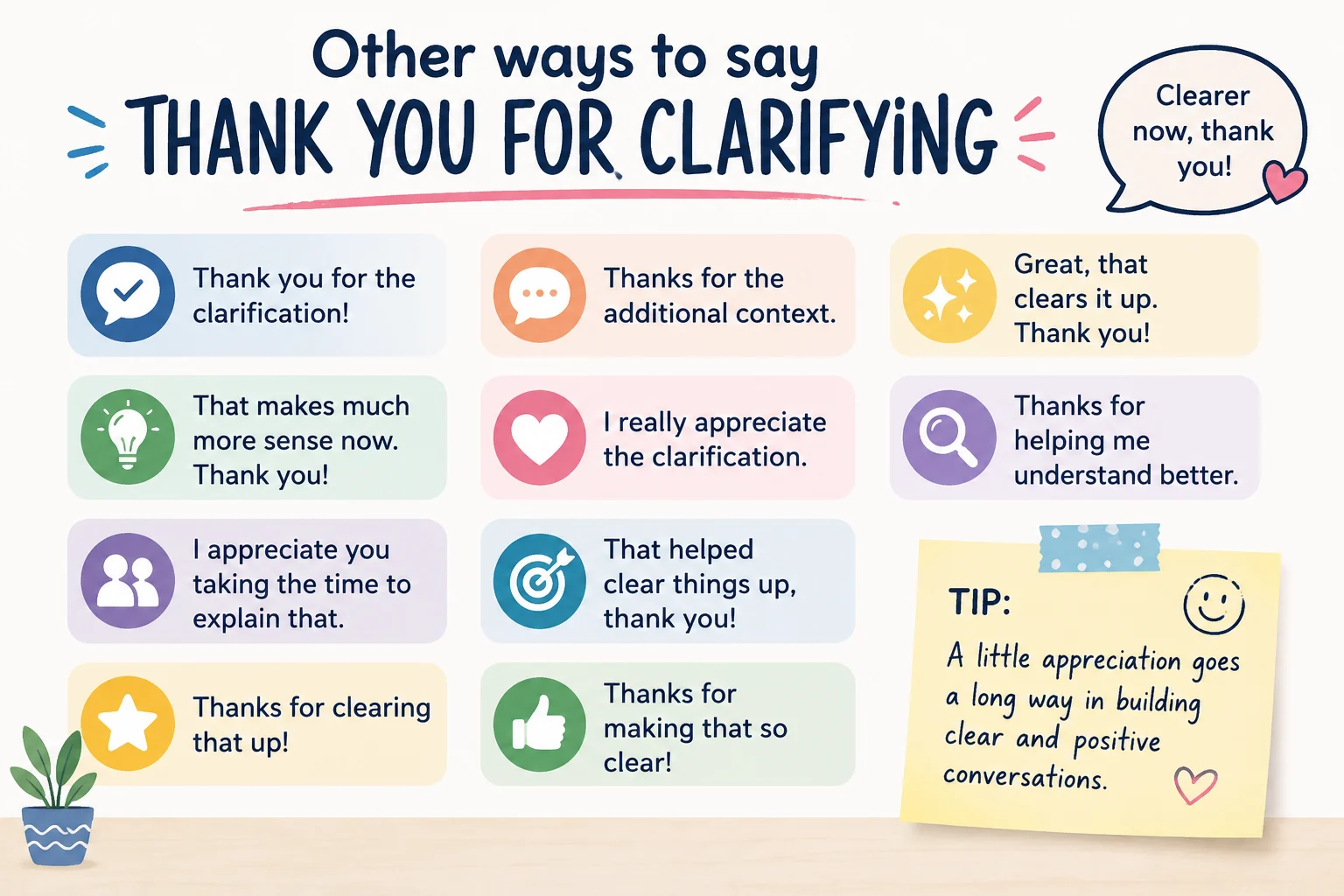
Other ways to say thank you for clarifying can make your conversations sound more natural, thoughtful, and professional. While “thank you for clarifying” is perfectly polite, repeating the same phrase in every email, text, or workplace conversation can make your communication feel a little predictable.
Fortunately, there are plenty of alternatives.
You can say “Thanks for clearing that up,” “I appreciate the clarification,” “Thanks for explaining,” or “That makes much more sense now.” Each phrase carries a slightly different tone. Some sound professional and polished, while others feel friendly, warm, or completely natural in casual conversations.
The trick is knowing which expression fits the situation.
If a coworker explains a confusing project requirement, you may want a professional response. If a friend clears up a misunderstanding, a casual phrase may feel better. And if a client provides additional information, you may want something respectful and polished.
This guide covers the best other ways to say thank you for clarifying, with practical examples, real-life scenarios, professional alternatives, email phrases, casual responses, and short expressions you can use immediately. For more insights, read here:- Other ways to say sorry for bothering you and Other ways to ask are you okay.
Quick Summary: Other Ways to Say Thank You for Clarifying
If you need a quick answer, here are some of the most useful other ways to say thank you for clarifying:
- Thanks for clearing that up.
- I appreciate the clarification.
- Thanks for explaining that.
- That makes much more sense now.
- Thanks for making that clear.
- I appreciate you explaining that.
- Thanks for helping me understand.
- That clears things up.
- Thanks for the additional context.
- I understand now—thank you.
- Thanks for taking the time to explain.
- I appreciate the extra information.
- Thanks for clearing up the confusion.
- That’s much clearer now.
- Thanks for walking me through it.
Best professional choice: “I appreciate the clarification.”
Best casual choice: “Thanks for clearing that up.”
Best warm choice: “Thanks for taking the time to explain.”
1. Why Use Other Ways to Say Thank You for Clarifying?
“Thank you for clarifying” is useful because it acknowledges that someone has made information easier to understand. However, other ways to say thank you for clarifying can help you match your response to the tone of the conversation.
For example, imagine your manager explains a confusing deadline. You could say:
“Thank you for clarifying.”
That’s perfectly acceptable.
But you could also say:
“I appreciate the clarification. That helps me plan the next steps.”
The second response sounds more specific because it shows that the explanation actually helped.
Here are several situations where other ways to say thank you for clarifying are useful:
- Someone explains an instruction.
- A coworker corrects a misunderstanding.
- A client provides missing information.
- A friend explains what they meant.
- A teacher makes a difficult concept easier.
- A manager explains a deadline.
- A customer-service agent explains a policy.
- Someone provides additional context.
- A colleague answers your follow-up question.
- Someone clears up confusion.
- A person explains a distinction.
- Someone corrects inaccurate information.
The psychology is simple: appreciation tells the other person that their explanation was useful.
2. Professional Other Ways to Say Thank You for Clarifying
Professional communication requires a balance between politeness and simplicity. You want to sound appreciative without sounding overly formal.
Here are excellent other ways to say thank you for clarifying in professional situations:
- I appreciate the clarification.
- Thank you for clearing that up.
- Thank you for explaining this.
- I appreciate the additional context.
- Thank you for providing that information.
- I appreciate you clarifying this.
- Thanks for helping clarify the situation.
- Thank you for making that distinction clear.
- I appreciate the explanation.
- Thank you for taking the time to explain.
- Thanks for providing further details.
- Your explanation was very helpful.
Real-life example
Manager: “The presentation is due Thursday, but the final financial figures won’t be needed until Monday.”
You: “I appreciate the clarification. That helps me prioritize the presentation.”
This is one of the strongest other ways to say thank you for clarifying because it acknowledges both the information and its usefulness.
3. Polite Alternatives for Formal Situations
There are situations where you want your response to sound particularly respectful. This may include communication with clients, senior colleagues, professors, customers, or business partners.
Consider these other ways to say thank you for clarifying:
- Thank you for providing further clarification.
- I greatly appreciate the clarification.
- Thank you for taking the time to explain this.
- I appreciate your explanation.
- Thank you for providing additional context.
- I appreciate the additional information.
- Thank you for helping me better understand the matter.
- I appreciate your assistance in clarifying this.
- Thank you for explaining the situation further.
- Your clarification is greatly appreciated.
- Thank you for making the situation clearer.
- I appreciate the additional details you provided.
Why these phrases work
Formal language is most effective when it remains natural. You don’t need an unnecessarily complicated sentence to sound respectful.
“I appreciate the clarification” is often stronger than a long, overly formal sentence because it is direct and professional.
4. Casual Other Ways to Say Thank You for Clarifying
Not every conversation needs formal language. When talking to friends, classmates, familiar coworkers, or family members, casual alternatives usually sound more natural.
Here are some easy other ways to say thank you for clarifying:
- Thanks for clearing that up.
- Thanks for explaining.
- Got it, thanks!
- That makes sense now.
- Ah, I get it now.
- Thanks, that helps.
- That clears things up.
- Now I understand.
- Thanks for making that clear.
- Okay, that makes much more sense.
- Gotcha—thanks for explaining.
- Thanks for straightening that out.
Example
Friend: “I wasn’t ignoring you. I was just busy with work.”
You: “Ah, that makes sense now. Thanks for clearing that up.”
In a casual conversation, this sounds more natural than using a formal phrase such as “I appreciate the clarification.”
5. Short Other Ways to Say Thank You for Clarifying
Sometimes you don’t need a detailed response. A short acknowledgment can keep the conversation moving.
Try these concise other ways to say thank you for clarifying:
- Thanks for explaining!
- Got it, thanks.
- Makes sense, thanks.
- Clear now, thanks!
- Thanks, that helps.
- Understood, thank you.
- That’s much clearer.
- I understand now.
- Thanks for the context.
- That clears it up.
- Appreciate the clarification.
- Thanks for confirming.
These work particularly well in:
- Slack messages
- Microsoft Teams
- Text messages
- Quick emails
- Group chats
- Workplace conversations
- Online discussions
A short response isn’t necessarily less appreciative. When the explanation was simple, a simple response can actually feel more natural.
6. Other Ways to Say Thank You for Clarifying in an Email
Email communication often requires slightly more polished wording. The best other ways to say thank you for clarifying should acknowledge the person’s explanation while keeping the message concise.
Try these:
- I appreciate the clarification regarding this matter.
- Thank you for clearing that up.
- Thank you for providing additional context.
- I appreciate the explanation.
- Thank you for taking the time to clarify this.
- I appreciate the additional information.
- Thank you for helping me better understand this.
- Your explanation was very helpful.
- Thank you for providing further details.
- I appreciate you taking the time to explain.
- Thank you for clarifying the situation.
- Thanks for helping resolve the confusion.
Email example
Thank you for providing additional context regarding the revised deadline. I appreciate the clarification and will adjust the schedule accordingly.
This approach is particularly useful because it does more than say thank you. It also shows that you understand what happens next.
7. Other Ways to Say Thank You for Clarifying a Misunderstanding
Misunderstandings can sometimes make conversations uncomfortable. The best response should acknowledge the explanation without making the other person feel blamed.
Useful other ways to say thank you for clarifying include:
- Thanks for clearing that up.
- I understand what you meant now.
- Thanks for explaining—I had misunderstood.
- That makes much more sense now.
- I appreciate you clearing that up.
- Thanks for helping me understand your point.
- I understand the situation better now.
- Thanks for explaining your perspective.
- I’m glad you clarified that.
- Thanks for setting the record straight.
- I appreciate you explaining the difference.
- Thanks for clearing up the misunderstanding.
Real-life example
Person: “I wasn’t saying the idea was bad. I meant that we should change the timing.”
You: “Thanks for explaining. I understand what you meant now.”
This response is useful because it shifts attention away from the disagreement and toward mutual understanding.
8. Warm Other Ways to Say Thank You for Clarifying
Sometimes a basic “thanks” doesn’t quite communicate how helpful someone has been.
If you want your response to sound warmer, try these other ways to say thank you for clarifying:
- Thanks for taking the time to explain that.
- I really appreciate you clearing that up.
- Thanks for helping me understand.
- I appreciate you explaining it so clearly.
- That was really helpful—thank you.
- Thanks for giving me some clarity.
- I appreciate the extra context.
- Thanks for walking me through it.
- I really appreciate the explanation.
- Thanks for making everything clearer.
- Your explanation helped a lot.
- Thanks for taking the time to make that clear.
When to use them
These are particularly effective when someone has spent significant time helping you.
For example:
“Thanks for walking me through that. I really appreciate the explanation.”
This communicates more gratitude than a simple “Okay, thanks.”
9. Other Ways to Say “That Makes Sense Now”
You don’t always need to explicitly say “thank you.” You can acknowledge that the explanation worked.
These expressions are useful other ways to say thank you for clarifying:
- That makes sense now.
- I understand now.
- That’s much clearer.
- I see what you mean now.
- That clears things up.
- I understand the distinction now.
- Now I see where the confusion was.
- That explains it.
- I have a much better understanding now.
- I see how it fits together now.
- That puts things into perspective.
- Everything makes more sense now.
For extra warmth, combine the acknowledgment with gratitude:
“That makes much more sense now. Thanks for explaining.”
This is one of the most natural responses in everyday conversation.
10. Other Ways to Thank Someone for Additional Context
Clarification doesn’t always mean that you were confused. Sometimes someone simply gives you information that you didn’t have before.
In these cases, other ways to say thank you for clarifying can focus on context:
- Thanks for the additional context.
- I appreciate the extra context.
- Thanks for providing more background.
- That context is really helpful.
- I appreciate the additional details.
- Thanks for filling me in.
- That gives me a better picture.
- Thanks for explaining the background.
- I appreciate the added perspective.
- Thanks for giving me more information.
- That helps put things into context.
- Thanks for providing some background.
Example
Coworker: “We’re changing the schedule because the supplier moved the delivery date.”
You: “Thanks for the additional context. That explains the change.”
Here, the phrase doesn’t imply that the coworker made a mistake. It simply acknowledges the useful information.
11. Workplace Chat Alternatives
Workplace messaging tends to be less formal than email, but professionalism still matters.
Some of the most natural other ways to say thank you for clarifying in Slack or Teams are:
- Thanks for clarifying!
- That clears things up.
- Got it, thanks.
- Thanks for the context.
- Makes sense now.
- Thanks for explaining.
- Appreciate the clarification.
- That’s much clearer now.
- Thanks for confirming.
- Understood—thank you.
- Thanks, that helps.
- I see what you mean now.
Example
Coworker: “Only the final version needs to be uploaded to the shared folder.”
You: “Got it, thanks for clarifying!”
Short, natural, and professional.
12. Other Ways to Say Thank You for Clarifying Without Repetition
If you communicate frequently, repeating exactly the same phrase can become monotonous.
Instead, rotate between different other ways to say thank you for clarifying based on the context.
| Situation | Alternative |
|---|---|
| Someone explains something | Thanks for explaining that. |
| Someone removes confusion | Thanks for clearing that up. |
| Someone gives more information | Thanks for the additional context. |
| Someone corrects a misunderstanding | I appreciate you clearing that up. |
| Someone explains a process | Thanks for walking me through it. |
| Someone answers your question | That makes sense now, thanks. |
| Someone provides details | I appreciate the additional information. |
| Someone confirms something | Thanks for confirming. |
| Someone explains a distinction | I understand the distinction now. |
| Someone spends time helping | Thanks for taking the time to explain. |
| Someone gives background | Thanks for filling me in. |
| Someone resolves confusion | That clears things up. Thanks. |
The objective isn’t to avoid the original phrase completely. It’s simply to give your communication more variety.
13. Best Other Ways to Say Thank You for Clarifying by Tone
Choosing the right alternative becomes much easier when you identify the tone first.
Professional
- I appreciate the clarification.
- Thank you for providing additional context.
- Thank you for clarifying this matter.
- I appreciate the additional information.
Friendly
- Thanks for clearing that up.
- That makes sense now.
- Thanks for explaining!
- Got it, thanks!
Warm
- Thanks for taking the time to explain.
- I really appreciate you clearing that up.
- That was really helpful—thank you.
- Thanks for helping me understand.
Formal
- Thank you for the clarification.
- I appreciate your explanation.
- Thank you for providing further clarification.
- I appreciate your assistance in clarifying this.
Very short
- Got it, thanks.
- Makes sense.
- Clear now.
- Thanks!
- Understood.
The best expression isn’t necessarily the most sophisticated one. It is the one that fits the relationship and situation.
14. Related Questions About Other Ways to Say Thank You for Clarifying
People searching for other ways to say thank you for clarifying often have questions about wording, tone, and professional communication.
What is another way to say “thank you for clarifying”?
You can say “Thanks for clearing that up,” “I appreciate the clarification,” “Thanks for explaining,” or “That makes much more sense now.”
Is “thank you for clarifying” professional?
Yes. “Thank you for clarifying” is polite, professional, and appropriate for workplace emails, meetings, business conversations, and customer communication.
What is a casual way to say thank you for clarifying?
“Thanks for clearing that up,” “Got it, thanks,” and “That makes sense now” are natural casual alternatives.
How do you thank someone for clearing up confusion?
You can say, “Thanks for clearing that up,” “I appreciate you explaining that,” or “That clears things up. Thank you.”
How do you say thank you for clarification in an email?
Try: “I appreciate the clarification regarding this matter,” or “Thank you for taking the time to provide additional context.”
Is “thanks for clarifying” rude?
No. It is generally polite and neutral. However, if the situation is sensitive, a warmer phrase such as “I appreciate you taking the time to explain” may be better.
What is another word for clarification?
Depending on the context, alternatives include explanation, context, details, information, guidance, confirmation, and background.
How do you respond after someone explains something?
A natural response is: “That makes sense now. Thanks for explaining.”
FAQ
1. What are the best other ways to say thank you for clarifying?
The best alternatives include “Thanks for clearing that up,” “I appreciate the clarification,” “Thanks for explaining,” “That makes much more sense now,” and “Thanks for providing additional context.”
2. What is the most professional way to say thank you for clarifying?
“I appreciate the clarification” is one of the safest professional expressions. It is concise, respectful, and appropriate for emails, meetings, and workplace communication.
3. What is a friendly alternative to thank you for clarifying?
“Thanks for clearing that up!” is a natural and friendly alternative that works well in everyday conversations.
4. How can I thank someone for explaining something in an email?
You can say, “Thank you for taking the time to explain this. I appreciate the additional context.”
5. How do you thank someone for clearing up a misunderstanding?
Say, “Thanks for clearing that up. I understand what you meant now.” This acknowledges the explanation without assigning blame.
6. Can I say “thanks for the clarification”?
Yes. “Thanks for the clarification” is concise, polite, and professional.
7. What is a short way to say thank you for clarifying?
“Got it, thanks,” “Makes sense, thanks,” “Clear now, thanks,” and “Thanks for explaining” are excellent short options.
8. How can I avoid repeating “thank you for clarifying”?
Use alternatives such as “Thanks for clearing that up,” “I appreciate the explanation,” “That makes sense now,” “Thanks for the context,” and “Thanks for walking me through it.”
Conclusion
The best other ways to say thank you for clarifying depend on the situation, relationship, and tone you want to create.
For professional conversations, “I appreciate the clarification” is a dependable choice. For casual conversations, “Thanks for clearing that up” sounds natural. When someone has invested significant effort in explaining something, “Thanks for taking the time to explain” adds a warmer touch.
You can also use phrases such as “That makes much more sense now,” “Thanks for the additional context,” or “I understand now—thank you.”
Ultimately, good communication is about making people feel heard, understood, and appreciated. A small expression of gratitude can turn an ordinary explanation into a positive interaction.
For a deeper look at the concept, you can explore the communication article on Wikipedia.