
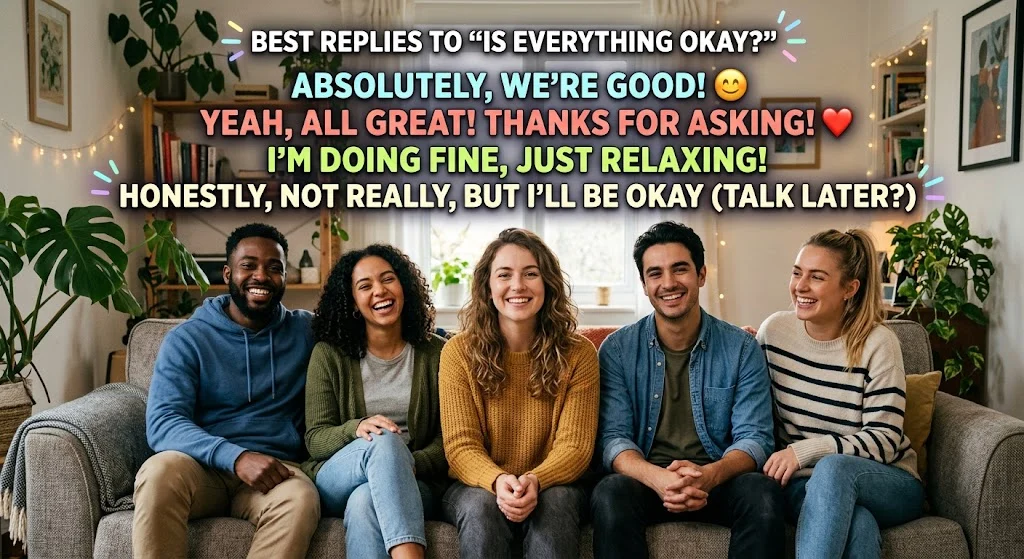
Introduction
“Is everything okay?” sounds like a simple question, but it can carry a surprising amount of meaning. Sometimes someone genuinely wants to know if you’re fine. Other times, they noticed your quiet mood, a short text, a strange expression, or the fact that you suddenly disappeared from the group chat like a Wi-Fi signal in a basement.
Knowing the best replies to is everything okay depends on what you actually want to communicate. You might want to reassure someone, be honest about your feelings, keep things private, make them laugh, or subtly tell them that something is definitely not okay.
The good news? You don’t have to give the same boring “Yeah, I’m fine” every time.
A thoughtful response can match the situation and your relationship with the person asking. In this guide, you’ll find funny, casual, honest, flirty, reassuring, short, professional, and emotionally open answers. You’ll also learn what different replies communicate and when each one works best.
Whether someone asks you face-to-face or sends “Is everything okay?” over text, these responses will help you answer naturally without making the conversation awkward. more clicks:-Best responses when someone says they like you or Best replies to happy Fourth of July .
Quick Summary Box
Looking for the best replies to is everything okay? Try these depending on your mood:
- Casual: “Yeah, I’m good. Just a little tired.”
- Honest: “Honestly, not really, but I appreciate you asking.”
- Reassuring: “Everything’s okay. Thanks for checking on me.”
- Funny: “Define ‘okay.’ 😂”
- Playful: “Why? Do I look suspicious?”
- Flirty: “It will be once you’re here.”
- Private: “I’m dealing with a few things, but I’ll be okay.”
- Short: “I’m alright, thanks.”
- Deep: “I’m getting through it one day at a time.”
- Conversation-opening: “Not completely. Want to talk?”
1. Why Do People Ask “Is Everything Okay?”
Before choosing among the best replies to is everything okay, it helps to understand why someone asked.
People usually ask this question because they have noticed something different. Maybe you’re quieter than usual, your messages became shorter, your energy changed, or your face is giving away more than your words.
Sometimes the question is genuine concern. Sometimes it’s curiosity. And occasionally, someone asks because they already know something is wrong and are simply giving you an opportunity to talk.
Here are natural ways to respond:
- “Yeah, I’m okay. Thanks for checking.”
- “I’m doing alright.”
- “I’ve just had a lot on my mind.”
- “Honestly, I’m not sure yet.”
- “Nothing serious, I promise.”
- “I appreciate you asking.”
- “I’m okay, just processing some things.”
- “Everything’s fine for now.”
- “I’m getting through it.”
- “Why do you ask?”
- “I’m better than I look.”
- “A little overwhelmed, but I’m okay.”
Real-life scenario: If a coworker notices that you’re unusually quiet, a simple “I’m okay, just have a lot on my mind” gives them enough information without turning a professional conversation into an emotional interview.
2. Best Casual Replies to “Is Everything Okay?”
Sometimes you don’t want to make the conversation serious. A casual answer keeps things relaxed while still acknowledging the person’s concern.
These are especially useful with friends, classmates, coworkers, or acquaintances.
- “Yeah, I’m good.”
- “All good over here.”
- “Yep, just tired.”
- “Nothing to worry about.”
- “I’m doing fine.”
- “Just having one of those days.”
- “Yeah, everything’s cool.”
- “I’m alright, promise.”
- “Just a little distracted.”
- “Nothing dramatic happening.”
- “I’m surviving.”
- “All systems are functioning… mostly.”
Real-life scenario: Your friend notices you haven’t said much during lunch. Instead of giving a long explanation, “Just having one of those days” keeps the conversation comfortable.
The psychology behind this kind of response is simple: you’re acknowledging their concern without necessarily inviting a deeper conversation.
3. Funny Replies to “Is Everything Okay?”
Humor can be one of the best ways to answer when the situation isn’t particularly serious.
A funny response works especially well when the person knows your personality and understands that you’re joking.
- “Define okay.”
- “That depends on your definition of okay.”
- “Ask me again after coffee.”
- “Emotionally? Let’s not discuss that.”
- “My lawyer advised me not to answer.”
- “I’m okay-ish.”
- “Operating on 12% battery.”
- “Everything except my sleep schedule.”
- “Technically, yes.”
- “My life has entered maintenance mode.”
- “I’m fine. The evidence is questionable.”
- “Let’s just say I’ve had better plotlines.”
Real-life scenario: A close friend sees you staring blankly at your phone and asks, “Is everything okay?” Saying “My life has entered maintenance mode” can get a laugh while still hinting that you’re having a rough day.
4. Honest Replies When Everything Is Not Okay
You don’t always have to pretend you’re fine. If someone you trust asks, being honest can create a meaningful conversation.
You don’t need to explain every detail. You can share only as much as you’re comfortable sharing.
- “Honestly, not really.”
- “I’ve been having a difficult day.”
- “There’s a lot going on right now.”
- “I’m struggling a little.”
- “I’m not feeling like myself today.”
- “Things have been stressful lately.”
- “I could actually use someone to talk to.”
- “I’m trying to work through it.”
- “I’m having a rough time, but I’ll get through it.”
- “I don’t really know how I feel yet.”
- “Something’s been bothering me.”
- “Thanks for asking. I actually needed someone to notice.”
Real-life scenario: If your closest friend asks because you’ve been unusually quiet, “Honestly, not really, but I appreciate you asking” is much more useful than automatically saying you’re fine.
Honesty also gives the other person a clear signal: you’re open to support.
5. Reassuring Replies When You Don’t Want Them to Worry
Sometimes everything really is okay, but the other person is concerned.
A reassuring response should sound warm rather than dismissive.
- “Everything’s okay, I promise.”
- “I’m completely fine.”
- “Nothing serious, don’t worry.”
- “I’m okay, just a little tired.”
- “Everything is under control.”
- “I appreciate your concern.”
- “I’m good, honestly.”
- “No need to worry about me.”
- “I’ve got it handled.”
- “Nothing’s wrong between us.”
- “I’m okay. Thanks for caring.”
- “Everything’s fine, just a long day.”
Real-life scenario: If your partner sees that you’re unusually quiet and asks whether something is wrong between you, “Nothing’s wrong between us. I’m just tired” can prevent unnecessary overthinking.
6. Short Replies to “Is Everything Okay?”
Not every conversation needs a paragraph.
If you’re busy, texting quickly, or simply don’t feel like talking, a short answer can work perfectly.
- “I’m okay.”
- “Yeah, all good.”
- “I’m fine.”
- “Doing okay.”
- “All good.”
- “I’m alright.”
- “Yep!”
- “Nothing’s wrong.”
- “I’m good, thanks.”
- “Everything’s fine.”
- “Just tired.”
- “I’ll be okay.”
Real-life scenario: If someone texts “Is everything okay?” while you’re in the middle of work, “Yeah, all good. Just busy!” is enough.
A short reply doesn’t necessarily mean you’re being rude. Context matters. If someone is genuinely concerned, however, adding “Thanks for checking” makes the answer warmer.
7. Flirty Replies to “Is Everything Okay?”
If the person asking is someone you like, “Is everything okay?” can become an opportunity for playful flirting.
The trick is to keep the response natural rather than overly dramatic.
- “It will be if you stay and talk to me.”
- “I was fine until you started worrying about me.”
- “Better now that you asked.”
- “Maybe I just needed your attention.”
- “Everything’s okay now that you’re here.”
- “Depends… are you planning to fix it?”
- “I could use a little distraction. You volunteering?”
- “I’m okay, but your concern is kind of cute.”
- “I might be better with some company.”
- “Nothing’s wrong. I just wanted you to notice.”
- “I’m fine. But I like that you care.”
- “Everything is suspiciously better when you text me.”
Real-life scenario: If someone you’re interested in notices your quiet mood and checks on you, “Better now that you asked” is subtle enough to flirt without turning the moment into a cheesy movie scene.
8. Playful Replies for Friends
Friends often ask “Is everything okay?” because they know your normal behavior. A playful response can keep the friendship’s usual energy alive.
- “Why, what did you hear?”
- “Do I look that suspicious?”
- “Should I be worried?”
- “Depends. Are you buying food?”
- “I’m fine. Probably.”
- “Everything except my bank account.”
- “Just fighting for my life against Monday.”
- “I’m okay, captain.”
- “Nothing a snack can’t solve.”
- “My emotional support playlist is handling it.”
- “Ask me after I eat.”
- “I’m alive, so that counts.”
Real-life scenario: When your friend sees you looking exhausted after a long day, “Nothing a snack can’t solve” makes the exchange lighter without pretending that you’re having the best day ever.
9. Polite Replies in Professional Situations
The best replies to is everything okay are different at work.
You probably don’t want to respond to your manager with an overly personal joke or explain your entire emotional state to a coworker you barely know.
Professional responses include:
- “Yes, everything is okay. Thank you.”
- “I’m fine, just focused on a few deadlines.”
- “Everything is under control.”
- “Thanks for checking in.”
- “I’m doing well.”
- “Nothing urgent, I appreciate your concern.”
- “I’m okay, just managing a busy workload.”
- “Everything is fine on my end.”
- “I’m good, thank you for asking.”
- “Just concentrating on the task at hand.”
- “Nothing to be concerned about.”
- “I’ll let you know if anything comes up.”
Real-life scenario: If your manager notices you’re unusually quiet during a meeting, “I’m fine, just focused on a few deadlines” is professional, reassuring, and appropriately private.
10. Replies That Invite Someone to Talk
Sometimes you want the person to explain why they asked.
This can be especially useful when you suspect they noticed something or have information you’re unaware of.
- “Why do you ask?”
- “Did something seem off?”
- “What makes you ask?”
- “Did I seem different today?”
- “Is there something you noticed?”
- “You tell me—do I seem okay?”
- “Was I acting strange?”
- “Did someone say something?”
- “What happened?”
- “Is there something I should know?”
- “You sound concerned. What’s up?”
- “Tell me why you’re asking.”
Real-life scenario: If someone suddenly asks whether everything is okay after a group conversation, “Why do you ask?” lets you gather context before deciding how much you want to reveal.
This response is particularly useful because it puts the conversation back on neutral ground.
11. Deep and Thoughtful Replies
For emotional conversations, a deeper response can communicate vulnerability without becoming overly dramatic.
- “I’m figuring things out.”
- “I’m okay, just not completely okay.”
- “Some days are easier than others.”
- “I’m taking things one day at a time.”
- “I’m trying to give myself some space.”
- “I’ve got a lot to process.”
- “I’m working through some things privately.”
- “I’m not where I want to be yet.”
- “I’m getting there.”
- “I appreciate you noticing.”
- “I don’t have all the answers right now.”
- “I’m doing my best with what I have.”
Real-life scenario: If a close friend asks about your mood during a serious conversation, “I’m okay, just not completely okay” communicates complexity without forcing you to explain everything.
Sometimes the most honest answer isn’t simply “yes” or “no.” Human emotions rarely fit into two boxes.
12. Replies When You Want Privacy
You are never obligated to explain everything just because someone asks.
A respectful boundary can be kind, clear, and firm.
- “I’m okay, but I’d rather not talk about it.”
- “Thanks for asking, but I need some space.”
- “I’m dealing with it privately.”
- “I appreciate you checking in.”
- “Nothing I want to discuss right now.”
- “I’ll talk about it when I’m ready.”
- “I’m okay enough to handle it.”
- “I’d rather keep that to myself for now.”
- “Thanks, but I’m not ready to talk.”
- “I appreciate the concern.”
- “I just need a little time.”
- “I’m fine, but I need some quiet.”
Real-life scenario: If an acquaintance asks about a personal issue in front of other people, “Thanks for asking, but I’d rather not talk about it here” protects your privacy without sounding hostile.
13. Texting Replies to “Is Everything Okay?”
Text messages create a unique problem: tone is easy to misunderstand.
A simple “fine” can sound angry, cold, or passive-aggressive depending on the relationship. Adding a few words can make your intention clearer.
Try these:
- “Yeah, I’m okay 😊”
- “Everything’s good, don’t worry.”
- “I’m fine, just tired.”
- “I’m okay. Thanks for checking ❤️”
- “Honestly, not really, but I’ll be okay.”
- “All good! Just busy.”
- “I’m alright. What made you ask?”
- “Nothing serious, promise.”
- “I’m okay, just having a weird day.”
- “Better now that you checked in.”
- “I’m getting through it.”
- “Can we talk about it later?”
Real-life scenario: If someone you care about texts “Is everything okay?” at night, “I’m okay, just tired. Thanks for checking ❤️” sounds much warmer than simply responding “Fine.”
14. How to Choose the Best Reply
The perfect response depends less on the exact words and more on who is asking, why they’re asking, and how you actually feel.
Think about these four questions:
Are you okay?
If yes, reassure them. If no, be honest with someone you trust.
Do you want to talk?
If you want a conversation, say something like “Honestly, not really. Can we talk?”
Do you want privacy?
Use a boundary such as “I appreciate you asking, but I don’t want to discuss it right now.”
What is your relationship?
A flirty response may work with someone you like, while a professional response is better with your manager.
Here are ten quick decision-based options:
- Want reassurance? — “Everything’s okay.”
- Want honesty? — “Honestly, I’ve been struggling.”
- Want privacy? — “I’d rather not talk about it.”
- Want humor? — “Define okay.”
- Want flirting? — “Better now that you asked.”
- Want conversation? — “Why do you ask?”
- Want space? — “I just need some time.”
- Want support? — “Actually, I could use someone to talk to.”
- Want to stay casual? — “Just having a weird day.”
- Want to end the topic? — “I’m okay, thanks for checking.”
The best answer is the one that matches your real feelings. You don’t need to perform happiness just to make someone else comfortable.
15. Related Questions People Ask
What is the best reply to “Is everything okay?”
A strong general response is: “Yeah, I’m okay. Thanks for checking on me.” If something is wrong, try: “Honestly, not really, but I appreciate you asking.”
How do you respond when someone asks if you are okay?
Match your answer to your feelings. You can say “I’m good,” “I’m having a rough day,” “I’m not ready to talk,” or “Actually, can we talk?”
What is a funny response to “Is everything okay?”
Try “Define okay,” “My lawyer advised me not to answer,” or “Everything except my sleep schedule.”
How do you respond to “Are you okay?” over text?
Keep it clear because texting can create misunderstandings. “Yeah, I’m okay, just tired” or “Honestly, I’m not doing great today” works well.
What should you say if everything is not okay?
You don’t need to overshare. Try “Honestly, not really,” “I’ve got a lot going on,” or “I could use someone to talk to.”
How do you politely avoid answering?
Say, “Thanks for asking, but I’d rather not talk about it right now.” This acknowledges their concern while maintaining your boundary.
What is a flirty reply to “Is everything okay?”
Try “Better now that you asked,” “Maybe I just needed your attention,” or “Everything’s okay now that you’re here.”
Should you always say “I’m fine”?
No. “I’m fine” is useful when you’re genuinely fine, but if you’re struggling and talking to someone you trust, an honest answer may lead to useful support.
FAQ
1. What are the best replies to “Is everything okay?”
The best reply depends on the situation. A safe all-purpose answer is, “Yeah, I’m okay. Thanks for checking.” If you’re not okay, “Honestly, not really, but I appreciate you asking” is more honest.
2. What is a good funny reply to “Is everything okay?”
“Define okay,” “Ask me after coffee,” and “My life has entered maintenance mode” are playful choices for friends who understand your humor.
3. How can I reply if I don’t want to talk?
You can say, “I appreciate you asking, but I’m not ready to talk about it.” This gives you a clear but respectful boundary.
4. What is a flirty response to “Is everything okay?”
“Better now that you asked” is one of the easiest flirty replies because it shows interest without being too intense.
5. What should I text when someone asks if I’m okay?
Try “Yeah, I’m okay, just tired,” “Everything’s good, thanks for checking,” or “Honestly, I’ve had a rough day. Can we talk?”
6. Is “I’m fine” a rude response?
Not necessarily. Tone and context matter. Adding “Thanks for checking” can make the response sound warmer and more appreciative.
7. How do I answer honestly without oversharing?
Give a general description rather than every detail. “I’ve got some things on my mind, but I’m handling them” is honest while still protecting your privacy.
8. Why does someone keep asking if everything is okay?
They may have noticed changes in your mood or behavior, genuinely care about you, or sense that you’re avoiding something. If you’re unsure, simply ask, “What makes you ask?”
Best Replies to “Is Everything Okay?” — Part 2 💬
Best Replies to “Is Everything Okay?” When You’re Actually Fine
Sometimes, the person asking has simply noticed that you’re quieter than usual. Maybe you’re concentrating, tired, checking your phone, or just lost in your own thoughts. In these situations, the best replies to is everything okay should reassure the other person without making the conversation unnecessarily serious.
You can keep your response natural and friendly:
- “Yeah, I’m completely fine.”
- “Everything’s good, promise.”
- “Yep, I’m just thinking.”
- “I’m good, just a little tired.”
- “Nothing’s wrong at all.”
- “All good on my end.”
- “I’m perfectly fine, thanks.”
- “Yeah, just having a quiet moment.”
- “Everything is okay. I appreciate you asking.”
- “I’m good—just mentally somewhere else.”
- “No worries, I’m fine.”
- “I’m okay, just taking it easy.”
Real-life scenario: Your friend notices that you’re unusually quiet during dinner and asks, “Is everything okay?” Instead of immediately assuming something is wrong, you can say, “Yeah, I’m good. Just tired today.” It reassures them while keeping the conversation relaxed.
Best Replies to “Is Everything Okay?” When You’re Upset
When you’re genuinely upset, pretending everything is perfect can sometimes make the situation harder. The best replies to is everything okay in this situation acknowledge your feelings without requiring you to explain everything.
Try these:
- “Not really, but I’ll be okay.”
- “I’m having a rough day.”
- “Something is bothering me.”
- “Honestly, I’m a little upset.”
- “I’ve got a lot on my mind.”
- “I’m not feeling my best today.”
- “I’m trying to process everything.”
- “It’s been a difficult day.”
- “I could use some time to myself.”
- “I’m struggling a little right now.”
- “I’m okay enough, just overwhelmed.”
- “Thanks for asking. I’m not doing great.”
Real-life scenario: A close friend notices you’re unusually quiet after receiving disappointing news. Saying, “Honestly, I’m a little upset, but I’ll be okay” is honest without turning the conversation into a full explanation.
Best Replies to “Is Everything Okay?” From Your Crush
When your crush asks whether you’re okay, you have plenty of room for playful, sweet, or slightly flirty answers. The best replies to is everything okay can turn an ordinary check-in into a cute conversation.
Here are some options:
- “I’m better now that you asked.”
- “Maybe I just needed your attention.”
- “Everything’s okay when you’re around.”
- “I’m fine, but I like that you noticed.”
- “I could definitely use some company.”
- “Are you volunteering to make my day better?”
- “I was waiting for you to ask.”
- “Nothing’s wrong. You’re just distracting me.”
- “I might be okay if you keep talking to me.”
- “Honestly, your message helped.”
- “I’m good. You checking on me is pretty cute.”
- “Everything is suspiciously better now.”
Real-life scenario: Your crush notices you’re quieter than usual and texts, “Is everything okay?” A response like “I’m better now that you asked” is warm and flirty without being overly intense.
Best Replies to “Is Everything Okay?” From Your Partner
When your boyfriend, girlfriend, spouse, or partner asks whether everything is okay, the answer carries more emotional weight. They probably know your normal behavior well enough to notice subtle changes.
The best replies to is everything okay should be honest and reassuring when possible.
- “Yeah, everything between us is okay.”
- “I’m just having a stressful day.”
- “Nothing is wrong with you.”
- “I’m okay, I just need a little time.”
- “I appreciate you checking on me.”
- “I’ve got some things on my mind.”
- “I’m fine, just emotionally tired.”
- “Can we talk about it later?”
- “Actually, I could use a hug.”
- “I’m okay. I just need you close.”
- “Nothing’s wrong between us, I promise.”
- “I’m having a hard time, but I’m glad you asked.”
Real-life scenario: Your partner notices you’ve been unusually quiet and asks if something is wrong with the relationship. Saying, “Nothing is wrong with us. I’m just having a stressful day” can prevent unnecessary anxiety and make your feelings clearer.
Best Replies to “Is Everything Okay?” When You Need Space
Not every emotional moment needs an immediate conversation. Sometimes you need time to understand your own feelings first.
In that situation, the best replies to is everything okay should establish a gentle boundary.
Consider these:
- “I’m okay, I just need some space.”
- “I appreciate you asking, but I need some quiet.”
- “I’ll be okay. I just need time.”
- “I’m processing some things right now.”
- “Can we talk about this later?”
- “I’m not ready to discuss it yet.”
- “Thanks for caring. I just need a little time.”
- “Nothing you need to fix right now.”
- “I’ll come to you when I’m ready.”
- “I’m handling it, just privately.”
- “I need a moment to clear my head.”
- “I’m okay enough; I just need some breathing room.”
Real-life scenario: If a friend repeatedly asks what’s wrong while you’re trying to calm down, “I appreciate you asking, but I need some quiet right now” is clear without being rude.
Best Replies to “Is Everything Okay?” When You Want Support
Sometimes someone asking this question is exactly the opening you needed. If you’re hoping they’ll listen, don’t be afraid to say so.
The best replies to is everything okay can invite support without making you feel like you’re demanding attention.
- “Actually, could we talk?”
- “Not really. I could use a friend.”
- “I’ve been struggling lately.”
- “Honestly, I needed someone to ask.”
- “Can I tell you what’s been going on?”
- “I could really use your advice.”
- “I’m not doing great today.”
- “Would you mind staying with me for a while?”
- “I have a lot on my mind.”
- “I don’t know what to do right now.”
- “I think talking would help.”
- “Thanks for asking. I actually want to tell you.”
Real-life scenario: If you’re overwhelmed and your closest friend asks whether you’re okay, “Honestly, I needed someone to ask” can open the door to a supportive conversation.
Sometimes people aren’t looking for solutions. They simply want someone to listen.
Best Replies to “Is Everything Okay?” When You’re Angry
Anger can make communication tricky. A sarcastic response may feel satisfying for five seconds and create a three-hour argument afterward.
If you’re angry but want to communicate clearly, choose one of these:
- “I’m upset, and I need a minute.”
- “No, I’m actually angry.”
- “Something happened that bothered me.”
- “I’m not ready to talk calmly yet.”
- “I need some time before we discuss this.”
- “I’m frustrated right now.”
- “I don’t want to say something I’ll regret.”
- “I’m angry, but I want to talk about it properly.”
- “Give me a little time.”
- “I’m trying to calm down first.”
- “Something crossed a line for me.”
- “We need to talk, but not while I’m this upset.”
Real-life scenario: Someone asks if you’re okay immediately after an argument. Instead of saying “I’m fine” sarcastically, “I’m upset, and I need a minute” gives you emotional space and prevents escalation.
Best Replies to “Is Everything Okay?” in a Text Conversation
Texting changes everything because the other person can’t hear your voice or see your facial expression.
A one-word response like “Fine” can accidentally sound cold. That’s why the best replies to is everything okay over text often include a little extra context.
Try:
- “Yeah, I’m okay 😊 Just tired.”
- “Everything’s fine, don’t worry.”
- “I’m good! Just been busy.”
- “Honestly, today has been rough.”
- “I’m okay. Thanks for checking ❤️”
- “Nothing serious, promise.”
- “I’m alright. What made you ask?”
- “I’m okay, just overwhelmed.”
- “Better now that you checked in.”
- “I’m fine, just having a weird day.”
- “Can we talk later?”
- “I’m not really okay, but I’ll explain when I can.”
Real-life scenario: Someone you care about texts, “Is everything okay?” while you’re busy. “Yeah, I’m okay 😊 Just tired. I’ll text you later” gives reassurance and explains why you’re not saying more.
Best Replies to “Is Everything Okay?” Without Saying “I’m Fine”
If you’ve used “I’m fine” approximately 4,000 times and want something different, you’re not alone.
There are plenty of natural alternatives:
- “I’m doing alright.”
- “I’m hanging in there.”
- “I’m getting through it.”
- “I’m okay for the most part.”
- “Things are manageable.”
- “I’m taking it one day at a time.”
- “I’m doing better.”
- “I’m holding up.”
- “I’m alright, just tired.”
- “I’m working through some things.”
- “I’m keeping myself together.”
- “I’m doing my best.”
Real-life scenario: A coworker asks whether you’re okay after a stressful week. “I’m hanging in there” communicates that you’re managing without inviting a deeply personal conversation.
Best Replies to “Is Everything Okay?” With Humor and Sarcasm
Sarcasm is great when the relationship supports it. It is considerably less great when the person is genuinely worried.
Use these with friends who understand your sense of humor:
- “Absolutely. Define absolutely.”
- “Depends who’s asking.”
- “Emotionally? No comment.”
- “My sleep schedule would disagree.”
- “Everything is under questionable control.”
- “I’m thriving in a very confusing way.”
- “Ask again after I eat.”
- “My life is currently buffering.”
- “I’m functioning, technically.”
- “Everything except my bank account.”
- “I have survived another episode.”
- “Nothing that dramatic… yet.”
Real-life scenario: Your best friend notices you looking exhausted and asks if everything is okay. “My life is currently buffering” can make them laugh while communicating that you’re having a strange day.
Best Replies to “Is Everything Okay?” From a Coworker
Work conversations require a little more diplomacy. You can answer honestly without giving your coworker access to your entire personal life.
Some professional responses include:
- “Yes, everything is okay. Thanks.”
- “I’m good, just focused.”
- “Nothing serious, thank you.”
- “I’m managing a busy workload.”
- “Everything is fine on my side.”
- “I appreciate you checking in.”
- “Just concentrating on a deadline.”
- “I’m doing well, thanks.”
- “Nothing to worry about.”
- “I’m okay, just a little tired.”
- “Everything is under control.”
- “I’ll let you know if I need anything.”
Real-life scenario: A coworker notices you’re quiet during a project meeting. “I’m good, just concentrating on a deadline” answers the question without oversharing.
Best Replies to “Is Everything Okay?” When You Don’t Know
Sometimes you genuinely don’t know whether you’re okay.
Maybe you’re emotionally overwhelmed, confused, or simply having an unusual day. You don’t have to manufacture a clear answer.
Try:
- “Honestly, I’m not sure.”
- “I’m still figuring that out.”
- “I don’t really know yet.”
- “I think I’m okay.”
- “I’m processing everything.”
- “It’s complicated.”
- “I’m somewhere between okay and overwhelmed.”
- “I need some time to understand how I feel.”
- “I’m not sure how to answer that.”
- “Some things are okay, some aren’t.”
- “I’m getting there.”
- “Ask me tomorrow.”
Real-life scenario: After a major life change, someone asks whether you’re okay. “I honestly don’t know yet” can be more authentic than forcing yourself to choose between “yes” and “no.”
Best Replies to “Is Everything Okay?” That Start a Deeper Conversation
A simple question can sometimes become an important conversation.
If you want to move beyond small talk, use a response that invites connection:
- “Actually, there’s something I’ve been meaning to tell you.”
- “Not completely. Can we talk?”
- “I’ve had a lot on my mind lately.”
- “You noticed something was off?”
- “I could really use someone to listen.”
- “There’s more going on than I’ve said.”
- “I’m glad you asked.”
- “Can I be honest with you?”
- “I’ve been keeping some things to myself.”
- “I think I’m ready to talk about it.”
- “There’s something bothering me.”
- “Yes and no. It’s complicated.”
Real-life scenario: A friend asks casually whether you’re okay, but you’ve actually been carrying something emotionally difficult. “Can I be honest with you?” signals that you’re ready for a deeper conversation.
How Psychology Changes the Right Response
The words someone uses when asking “Is everything okay?” can reveal a lot about the conversation.
If they say it casually, they may simply be checking in. If they ask twice, they may have noticed something more significant. If they say it softly or privately, they may be creating a safe opportunity for you to open up.
That is why the best replies to is everything okay aren’t one-size-fits-all.
Think about the emotional context:
- Concern: Reassure them or explain what you need.
- Curiosity: Decide whether you want to share.
- Friendship: Humor or honesty can work.
- Romance: Warmth and vulnerability usually work better.
- Work: Keep your response professional.
- Conflict: Avoid sarcastic answers that could escalate things.
- Privacy: Set a clear boundary.
- Emotional support: Let the person know if you need them.
The most useful response is often the simplest truthful one.
Final Thoughts
The best replies to “Is everything okay?” depend on the moment, your relationship, and how you genuinely feel. Whether you choose humor, honesty, or a simple reassurance, the right communication can make the conversation feel natural and meaningful.
Sometimes a simple “I’m good” is enough. Other times, “Actually, can we talk?” can open the door to a much-needed conversation.