
Introduction
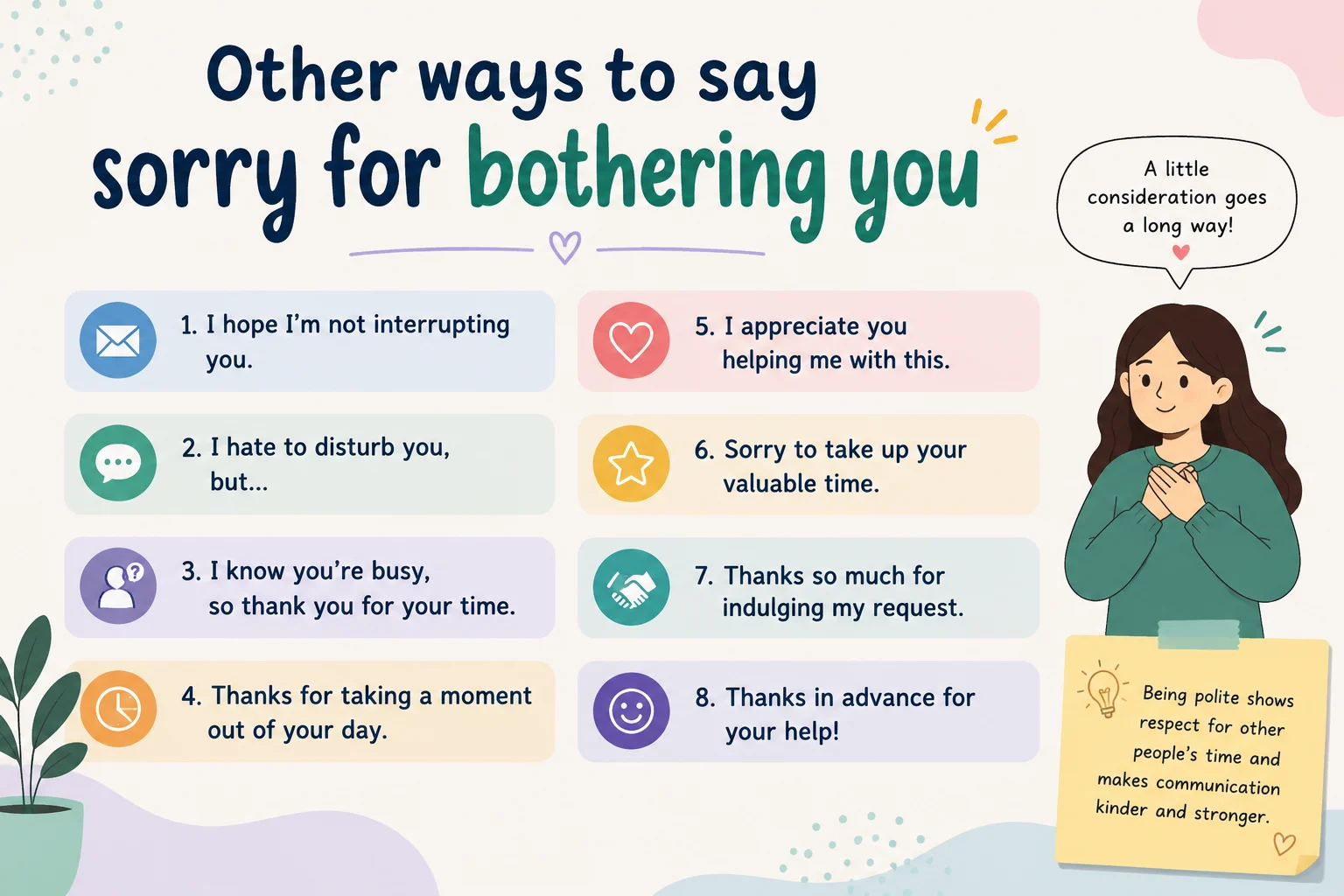
Other ways to say sorry for bothering you can help you sound more confident, thoughtful, and natural in almost any conversation. Although “sorry for bothering you” is polite, repeating the same phrase can sometimes make you sound overly apologetic—even when you haven’t actually done anything wrong.
Think about the situations where this happens. You need to ask a coworker a quick question. You want to follow up on a message. You need a friend’s help. You are interrupting someone who appears busy. Or perhaps you’re texting someone you haven’t spoken to in a while and don’t want to seem intrusive.
In each situation, other ways to say sorry for bothering you can make your message fit the moment better.
Sometimes you need a simple “Sorry to interrupt.” Other times, “I hope I’m not catching you at a bad time” sounds more considerate. With a friend, “Sorry to bug you” may feel more natural. At work, “When you have a moment” can be more confident and professional.
The key isn’t simply finding a replacement. It’s choosing language that matches your relationship, situation, and tone. For more insights, read here:- Other ways to say I need your help and Other ways to say thank you for your continued support.
Quick Summary: Other Ways to Say Sorry for Bothering You
If you’re searching for other ways to say sorry for bothering you, these are some of the most useful options:
- Sorry to interrupt.
- I hope I’m not disturbing you.
- I hope I’m not catching you at a bad time.
- Sorry to trouble you.
- I hope I’m not being a bother.
- Sorry for taking up your time.
- I apologize for the interruption.
- I hope I’m not inconveniencing you.
- Sorry to bother you again.
- Thanks for taking a moment.
- Do you have a quick minute?
- When you have a moment, could you help me?
- I know you’re busy, but I have a quick question.
- Let me know if now isn’t a good time.
- I appreciate you making time for me.
These other ways to say sorry for bothering you work across texts, emails, workplace conversations, friendships, customer service, and everyday situations.
Why Look for Other Ways to Say Sorry for Bothering You?
There is nothing inherently wrong with saying “sorry for bothering you.” The phrase communicates consideration and acknowledges that another person’s time matters.
However, other ways to say sorry for bothering you can give you more control over your tone.
For example, “Sorry for bothering you” can sound apologetic. “Do you have a moment?” sounds confident. “I hope I’m not catching you at a bad time” sounds thoughtful. “Sorry to bug you” sounds friendly.
Here are ten alternatives:
- Sorry to interrupt.
- I hope I’m not disturbing you.
- I hope I’m not being a bother.
- Sorry to trouble you.
- I hope this isn’t a bad time.
- Sorry for taking your time.
- Do you have a minute?
- Could I ask you something quickly?
- When you have a moment, could you help me?
- I appreciate you taking a moment.
Real-life scenario: If your manager is working on a deadline, “I hope I’m not catching you at a bad time” recognizes their situation without assuming your question is an inconvenience.
Polite Other Ways to Say Sorry for Bothering You
When you want to remain respectful, the best other ways to say sorry for bothering you are gentle without sounding excessively formal.
Consider these options:
- I hope I’m not disturbing you.
- Sorry to interrupt.
- I hope I’m not inconveniencing you.
- Sorry to trouble you.
- I hope I’m not being a bother.
- I apologize for the interruption.
- Sorry for taking up your time.
- I hope this isn’t a bad time.
- I hope I’m not imposing.
- I appreciate you taking a moment.
These expressions are particularly useful when speaking to someone you don’t know well.
Real-life scenario: If you’re asking a stranger for directions, “Excuse me, I hope I’m not disturbing you. Could you tell me where the station is?” is polite and natural.
Professional Other Ways to Say Sorry for Bothering You
Professional communication requires a slightly different approach. You want to acknowledge someone’s workload without making your request sound like an inconvenience.
Useful other ways to say sorry for bothering you at work include:
- I hope I’m not catching you at a bad time.
- When you have a moment, could you please take a look?
- I know you’re busy, but I have a quick question.
- Could I ask for your input?
- Would you mind reviewing this?
- I appreciate you taking the time.
- When convenient, could you help me with this?
- Do you have a moment to discuss this?
- Could I quickly run something by you?
- Thank you for making time for me.
Real-life scenario: Instead of writing, “Sorry for bothering you, can you review this?” try, “When you have a moment, could you please review this?” The second version sounds confident while remaining courteous.
Casual Other Ways to Say Sorry for Bothering You
With friends, family, and people you know well, formal language can sound strangely stiff. Casual other ways to say sorry for bothering you are usually shorter.
Try these:
- Sorry to bug you.
- Hope I’m not bothering you.
- Quick question!
- Got a minute?
- Hope I’m not interrupting.
- Sorry for the random message.
- Can I ask you something?
- Mind if I ask you a quick question?
- Sorry to bug you again.
- Let me know if you’re busy.
Real-life scenario: If you’re texting a friend who hasn’t responded yet, “Hey, hope I’m not bothering you—just wanted to ask something” sounds relaxed rather than overly serious.
Other Ways to Say Sorry for Bothering You in a Text
Texting gives you more freedom to keep your wording short. You don’t need a long apology before getting to your actual question.
Some natural other ways to say sorry for bothering you in texts are:
- Hope I’m not disturbing you.
- Sorry to bug you.
- Quick question?
- Are you free for a second?
- Got a minute?
- Hope I’m not interrupting anything.
- Sorry for the random message.
- Can I ask you something?
- Let me know if you’re busy.
- Sorry to bother you again.
Real-life scenario: If you’re messaging someone late in the day, “Hope I’m not disturbing you—quick question when you get a chance” is considerate without sounding dramatic.
Other Ways to Say Sorry for Bothering You at Work
Workplace interruptions are common, so you don’t always need a formal apology. Often, asking whether someone is available is enough.
Here are ten useful other ways to say sorry for bothering you at work:
- Do you have a quick minute?
- Is now a good time?
- Could I run something by you?
- Can I ask you something quickly?
- When you have a moment, could you help me?
- I know you’re busy, so I’ll keep this brief.
- Could I get your input?
- Would you mind taking a quick look?
- Let me know if you’d rather discuss this later.
- Can I borrow a minute?
Real-life scenario: Walking over to a colleague and asking, “Do you have a quick minute?” is often more natural than repeatedly apologizing for interrupting their workflow.
Other Ways to Say Sorry for Bothering You Again
Following up can be uncomfortable. You don’t want to appear impatient, but you also don’t want your original message to disappear into someone’s inbox.
These other ways to say sorry for bothering you are useful for follow-ups:
- Just following up on my previous message.
- I wanted to check in when you have a moment.
- Just checking whether you had a chance to see this.
- I wanted to gently follow up.
- Just circling back on this.
- I hope my previous message didn’t get missed.
- Whenever you have a moment, I’d appreciate an update.
- I know you’re busy, so there’s no rush.
- Just wanted to check where things stand.
- Please let me know when convenient.
Real-life scenario: Instead of “Sorry for bothering you again,” a professional email could begin, “Just following up on my previous message when you have a moment.”
Other Ways to Say Sorry for Bothering You When Asking for Help
Asking for help doesn’t automatically mean you’re inconveniencing someone. You can be polite while sounding confident.
Here are helpful other ways to say sorry for bothering you when requesting assistance:
- Could I ask you for a quick favor?
- Would you mind helping me with this?
- Could I get your advice?
- If you have a moment, could you help me?
- I could really use your input.
- Would you mind taking a look?
- Could you give me a hand with this?
- Do you have time to help me?
- I’d appreciate your opinion.
- Could I get your thoughts on something?
Real-life scenario: Rather than “Sorry for bothering you, can you help me?” try “If you have a moment, could I get your advice?” The wording remains respectful but sounds more self-assured.
Friendly Other Ways to Say Sorry for Bothering You
Friends usually don’t need elaborate apologies. In fact, too much formality can make a friendly message sound strangely distant.
Use these other ways to say sorry for bothering you:
- Sorry to bug you.
- Hope I’m not bothering you.
- Got a second?
- Quick question.
- Can I steal a minute?
- Sorry for bugging you again.
- Mind if I ask something?
- Hope I’m not interrupting.
- One quick thing.
- Sorry for popping up again.
Real-life scenario: If you need your friend’s opinion about something, “Got a second? I need your brutally honest opinion” can feel much more natural than a formal apology.
Sweet and Considerate Other Ways to Say Sorry for Bothering You
Sometimes you want your message to sound particularly thoughtful. In those cases, focus on appreciation rather than excessive apologizing.
Try these other ways to say sorry for bothering you:
- I hope I’m not taking too much of your time.
- I really appreciate you listening.
- Thanks for giving me a moment.
- I hope I’m not inconveniencing you.
- I appreciate your patience.
- Thanks for hearing me out.
- I hope this isn’t a bad time.
- I appreciate you making time for me.
- Thanks for taking a moment to help.
- I hope I’m not interrupting anything important.
Real-life scenario: When someone agrees to help with a complicated problem, “I really appreciate you making time for me” often sounds warmer than repeatedly saying “sorry.”
Other Ways to Say Sorry for Bothering You While Interrupting
An interruption deserves acknowledgment when you’ve genuinely cut into someone’s conversation, work, or activity.
Here are ten other ways to say sorry for bothering you when interrupting:
- Sorry to interrupt.
- Excuse me for interrupting.
- I apologize for interrupting.
- Sorry to jump in.
- Excuse me, may I add something?
- Sorry for cutting in.
- May I quickly clarify something?
- I hope I didn’t interrupt anything important.
- Sorry to jump into the conversation.
- May I briefly interrupt?
Real-life scenario: During a meeting, “Sorry to jump in—could I clarify one point?” is concise and professional.
Funny Other Ways to Say Sorry for Bothering You
Humor can work when you’re talking with someone you’re comfortable with. Keep it light and make sure the relationship supports that style.
Try these playful other ways to say sorry for bothering you:
- Sorry to invade your inbox.
- Tiny question incoming.
- I promise this will be quick.
- Sorry to disturb the peace.
- I come bearing one small question.
- Sorry for my unexpected appearance.
- One quick thing, I swear.
- Sorry to interrupt your very important business.
- Sorry to be that person again.
- Apologies for my dramatic entrance.
Real-life scenario: When messaging a close friend, “Tiny question incoming—I promise this is the last one” can turn an ordinary interruption into a playful interaction.
When You Shouldn’t Say Sorry for Bothering Someone
Here’s an important point: sometimes you don’t need other ways to say sorry for bothering you because you don’t need to apologize at all.
If you’re asking a reasonable question during an appropriate time, you’re not necessarily bothering someone.
Instead of:
“Sorry to bother you, but could you explain this?”
Try:
“Could you explain this when you have a moment?”
Other confident alternatives include:
- Do you have a moment?
- Could you clarify this?
- Can I ask you something?
- I’d appreciate your input.
- When convenient, could you take a look?
- Could you help me understand this?
- May I ask a quick question?
- Could you give me your opinion?
- When you’re free, could we discuss this?
- Thanks for your time.
Real-life scenario: If you’re contacting a coworker about a normal work responsibility, apologizing for sending the message can make a routine interaction seem more serious than it is.
How to Choose the Best Alternative
The best other ways to say sorry for bothering you depend on four things: your relationship, the setting, your urgency, and the tone you want.
For friends
Use:
- Sorry to bug you.
- Got a second?
- Quick question.
- Hope I’m not bothering you.
For coworkers
Use:
- Do you have a quick minute?
- Could I run something by you?
- Is now a good time?
- When you have a moment…
For managers
Use:
- When convenient, could you please…?
- I hope I’m not catching you at a bad time.
- Could I get your input?
- I appreciate your time.
For strangers
Use:
- Excuse me.
- Sorry to interrupt.
- I hope I’m not disturbing you.
- Could I ask a quick question?
For follow-ups
Use:
- Just following up.
- I wanted to check in.
- Just circling back.
- Whenever you have a moment…
Choosing the right expression makes other ways to say sorry for bothering you sound natural instead of forced.
Common Mistakes When Saying Sorry for Bothering Someone
Even polite language can become ineffective when overused. The goal of other ways to say sorry for bothering you is to sound considerate, not insecure.
Avoid these common mistakes:
- Apologizing multiple times in one message.
- Saying sorry before every simple question.
- Writing a huge apology for a tiny request.
- Assuming you’ve inconvenienced someone.
- Using professional language with close friends.
- Sounding guilty for asking for normal assistance.
- Sending multiple apologies during a follow-up.
- Avoiding the actual question.
- Adding unnecessary explanations.
- Turning a simple request into an emotional confession.
For example:
Too apologetic:
“I’m really sorry to bother you, and I apologize for interrupting, but if it isn’t too much trouble, could you maybe help me?”
Better:
“When you have a moment, could you help me with this?”
The second version is shorter, clearer, and more confident.
FAQ: Other Ways to Say Sorry for Bothering You
What are the best other ways to say sorry for bothering you?
Some of the best alternatives are “Sorry to interrupt,” “I hope I’m not disturbing you,” “I hope I’m not catching you at a bad time,” “Sorry to trouble you,” and “I hope I’m not being a bother.”
What are other ways to say sorry for bothering you in a text?
Natural text alternatives include “Hope I’m not disturbing you,” “Sorry to bug you,” “Quick question,” “Got a minute?” and “Let me know if you’re busy.”
What are professional other ways to say sorry for bothering you?
For professional communication, try “When you have a moment,” “I hope I’m not catching you at a bad time,” “Could I get your input?” or “I appreciate you taking the time.”
How do I say sorry for bothering someone again?
Instead of repeatedly apologizing, say “Just following up on my previous message,” “I wanted to check in,” or “Just circling back when you have a moment.”
Is sorry for bothering you polite?
Yes. “Sorry for bothering you” is generally polite and considerate. However, you don’t need to use it every time you contact someone.
How do I ask for help without sounding annoying?
Keep your request short and respectful. Try “Could I ask you for a quick favor?” or “When you have a moment, could you help me with this?”
What is a casual way to apologize for bothering someone?
“Sorry to bug you,” “Hope I’m not bothering you,” and “Quick question” are natural casual options.
Should I apologize for sending a normal message?
Not necessarily. If you’re contacting someone appropriately and have a reasonable question, you can simply ask your question politely.
Conclusion
Knowing other ways to say sorry for bothering you helps you communicate with more confidence and flexibility. You don’t always need to apologize for asking a question, requesting assistance, or following up. Sometimes a simple “Do you have a moment?” is all you need.
The best other ways to say sorry for bothering you depend on the situation. Use “Sorry to bug you” with close friends, “Sorry to interrupt” when you’ve genuinely interrupted someone, and “When you have a moment” for professional requests.
Most importantly, remember that communication is a two-way interaction. If your request is reasonable, respectful, and appropriately timed, you are not automatically creating a problem.
A thoughtful phrase can show respect without making you sound uncertain. Choose the wording that fits the relationship, keep your message clear, and let your confidence speak alongside your courtesy.
2 thoughts on “Other Ways to Say Sorry for Bothering You: Powerful & Polite Alternatives for 2026 💬”