
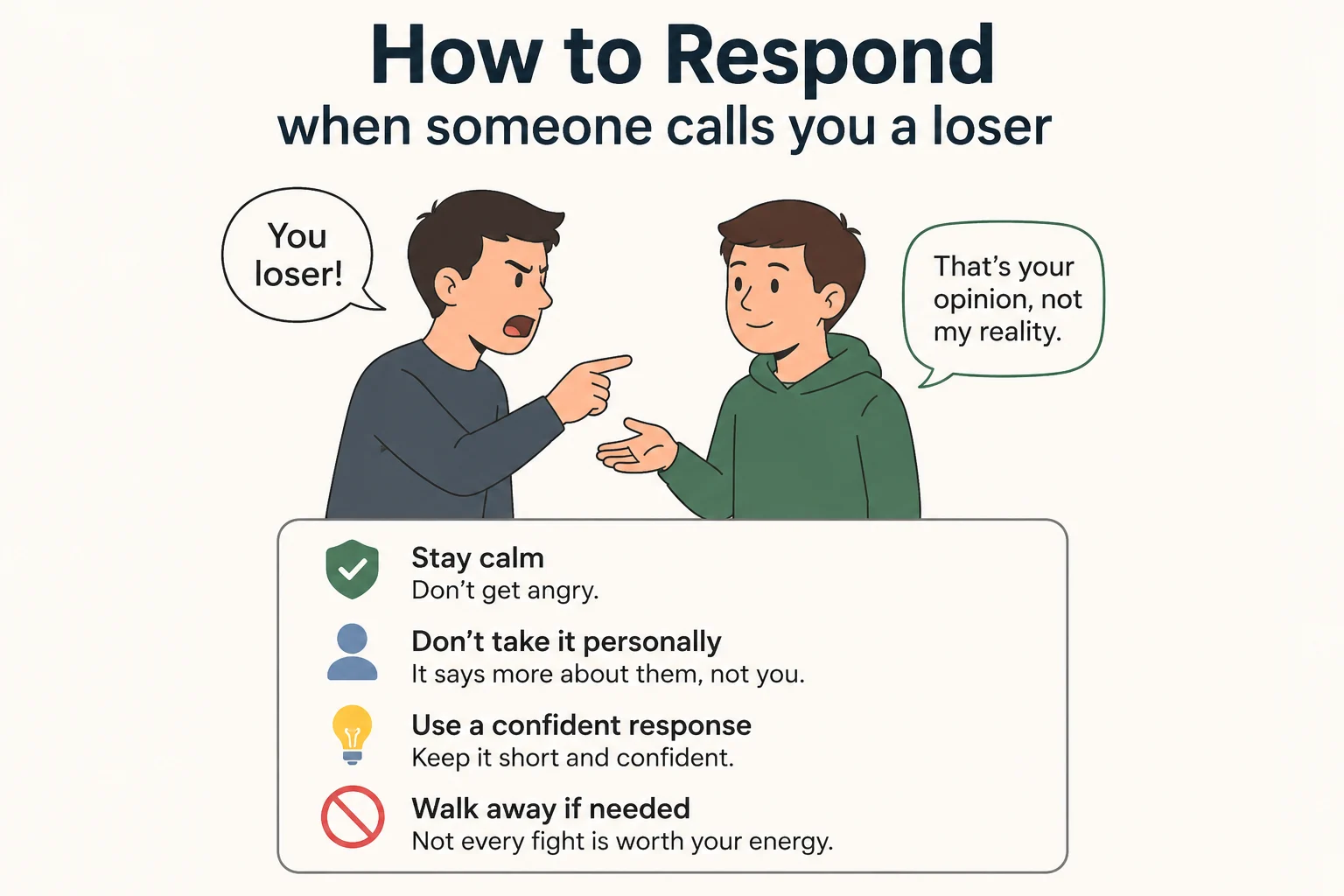
Quick Summary Box
TL;DR: How to respond when someone calls you a loser comes down to five approaches — calm confidence, humor, direct confrontation, silence, and boundary-setting — and the right one depends on who said it and where. Below you’ll find 60+ example lines, the psychology behind why insults like this happen, and word-for-word scripts for texts, in-person confrontations, workplace jabs, family dinners, and online trolls.
How to respond when someone calls you a loser is a question most of us only Google after the sting has already landed. Maybe it was a sibling at Thanksgiving, an ex in a group chat, a coworker in a meeting, or a stranger on Instagram. Your chest tightened, your mind went blank, and now — hours later — you’re still replaying the moment like it’s on a loop.
First: you’re not overreacting. Words like that are designed to sting, and the sting is real even when the insult is baseless. Second: the fact that you’re looking for a response instead of just stewing means you’re already ahead. This guide isn’t about winning an argument — it’s about walking away with your dignity intact, your composure visible, and (often) the other person looking worse than you do.
We’ll cover the psychology of why people call others “losers,” the exact wording you can use in a dozen real situations, and how to tell the difference between a joke worth laughing off and a pattern worth confronting. By the end, you’ll know exactly how to respond when someone calls you a loser — no matter who says it or where. For more insights, read here:- How to respond to being called a tease and How to respond to do you come here often.
How to Respond When Someone Calls You a Loser: Understanding the Psychology Behind It
Calling someone a loser is rarely about the target — it’s almost always about the speaker’s own insecurity, need for control, or attempt to look powerful in front of an audience. Understanding why it happens takes the sting out of it.
Common psychological drivers:
- Projection — they feel like they’re falling behind and it’s easier to point at someone else
- Status anxiety — especially common in group settings where someone wants to look dominant
- Learned behavior — they grew up in a household where insults were normal currency
- Deflection — they got called out for something and are redirecting attention
- Boredom or attention-seeking — trolls online often just want a reaction
- Jealousy — genuinely, often about something specific (your job, your relationship, your confidence)
- Testing you — some people insult to see how much power they have over your emotions
- Habitual teasing — friend groups sometimes normalize harsh banter that’s not meant maliciously
- Displaced anger — they’re upset about something unrelated and you’re a convenient target
- Low emotional intelligence — they genuinely don’t know a better way to express frustration
Real-life scenario: A coworker snaps “must be nice being such a loser with no ambition” after you turn down a project. Nine times out of ten, that’s not about you — it’s about their fear that you made a smarter call than they did.
How to Respond When Someone Calls You a Loser: The 3-Second Rule Before You Say Anything
Before crafting a comeback, your nervous system needs a beat. This is the single most important — and most skipped — step.
- Take one slow breath before responding (it physically lowers your heart rate)
- Notice the urge to defend yourself immediately — and resist it
- Ask internally: “Is this person someone whose opinion matters to me?”
- Decide your goal: de-escalate, deflect, confront, or exit
- Remember: silence is also a response, and often the most powerful one
- Check your tone before you check your words — flat and calm beats loud and shaky
- If typing a reply, write it, then wait 60 seconds before sending
- If in person, it’s fine to say “give me a second” out loud
- Scan the room — is this a public dig meant for an audience, or private?
- Remind yourself the goal isn’t to “win,” it’s to leave feeling like yourself
This pause is what separates a devastating comeback from a defensive scramble that gives the loser comment power over you.
How to Respond When Someone Calls You a Loser With Calm Confidence (No Anger Required)
If you want to know how to respond when someone calls you a loser without raising your voice, this is your category — these lines work almost anywhere because they signal you’re unbothered, which is usually the opposite of what the other person wanted.
- “Okay. Anyway—” (then just continue the conversation)
- “That’s an interesting opinion to lead with.”
- “Noted. Moving on.”
- “I’ll take that under advisement.”
- “Cool story.”
- “If that’s the worst thing you’ve got, I’m doing pretty well.”
- “You clearly put some thought into that.”
- “Thanks for sharing.” when learning how to respond when someone calls you a loser
- “I appreciate the feedback, truly.” as part of how to respond when someone calls you a loser
- “That says more about your day than mine.” a key piece of how to respond when someone calls you a loser
- “Alright. What’s next?” — a real example of how to respond when someone calls you a loser
- “I’ve been called worse by better people.” (this is how to respond when someone calls you a loser)
Real-life scenario: A group-chat troll writes “lol you’re such a loser for still living with your parents.” Reply: “Saving money while you pay rent to feel superior. Noted.” — calm, factual, no anger.
How to Respond When Someone Calls You a Loser With Humor (Disarm With a Laugh)
Humor works because it reframes the insult as amusing rather than threatening — and it’s genuinely fun to deploy.
- “Damn, and here I thought I was doing great.” which shows how to respond when someone calls you a loser
- “Losing? I prefer ‘strategically taking my time.'” when learning how to respond when someone calls you a loser
- “Wow, harsh. I’ll add it to my resume.” as part of how to respond when someone calls you a loser
- “Careful, my ego’s fragile — oh wait, no it’s not.” a key piece of how to respond when someone calls you a loser
- “I’ll frame that and hang it next to my participation trophies.” — a real example of how to respond when someone calls you a loser
- “Bold words from someone who just [insert their own recent flop].” (this is how to respond when someone calls you a loser)
- “That’s rich coming from you.” which shows how to respond when someone calls you a loser
- “I’m a loser with great taste, thanks for noticing.” — another way to think about how to respond when someone calls you a loser
- “Aw, did I live rent-free in your head again today?” when learning how to respond when someone calls you a loser
- “New nickname unlocked. I’ll allow it.” as part of how to respond when someone calls you a loser
- “Say that again but slower, I want to savor it.” a key piece of how to respond when someone calls you a loser
- “Loser core is actually trending, so… thanks?” which ties back to how to respond when someone calls you a loser
Real-life scenario: A sibling jokes “you’re such a loser, still no promotion?” at a family dinner. A light “Guess I’m just built for a slow burn — unlike your last three jobs” gets a laugh from the table and shuts it down without drama.
How to Respond When Someone Calls You a Loser Directly (No-Nonsense Responses)
Sometimes calm or funny isn’t enough — you want to name the behavior plainly.
- “That’s not okay, and I’d like you to stop.” — a real example of how to respond when someone calls you a loser
- “Calling me names isn’t going to change how I see myself.” (this is how to respond when someone calls you a loser)
- “I’m not going to engage with insults.” which shows how to respond when someone calls you a loser
- “You can disagree with me without name-calling.” when learning how to respond when someone calls you a loser
- “That comment wasn’t necessary.” as part of how to respond when someone calls you a loser
- “I hear that you’re frustrated, but this isn’t the way to say it.” a key piece of how to respond when someone calls you a loser
- “I’m going to need you to talk to me differently.” — a real example of how to respond when someone calls you a loser
- “That’s a low blow, and you know it.” (this is how to respond when someone calls you a loser)
- “I won’t be spoken to like that.” which shows how to respond when someone calls you a loser
- “Let’s keep this respectful or we’re done talking.” when learning how to respond when someone calls you a loser
Real-life scenario: A manager mutters “must be nice being a loser who leaves at 5pm” in front of the team. A steady “I finish my work and leave on time — that’s not a punchline” resets the tone instantly and on the record.
How to Respond When Someone Calls You a Loser Using Silence and Walking Away
Sometimes the most effective “comeback” is no comeback at all. Silence denies the person the emotional reaction they were fishing for.
- Make brief eye contact, then simply change the subject as part of how to respond when someone calls you a loser
- Physically step away from the conversation a key piece of how to respond when someone calls you a loser
- Respond to a completely different part of what they said, ignoring the insult — a real example of how to respond when someone calls you a loser
- Say nothing and let the silence sit — most people get uncomfortable filling it themselves (this is how to respond when someone calls you a loser)
- Exit the chat or mute the thread without a reply which shows how to respond when someone calls you a loser
- Redirect to someone else in the group: “Anyway, what were you saying earlier?” when learning how to respond when someone calls you a loser
- Give a small, unreadable smile and move on as part of how to respond when someone calls you a loser
- Simply say “okay” and nothing more a key piece of how to respond when someone calls you a loser
- Leave the room if it’s a repeated pattern — a real example of how to respond when someone calls you a loser
- Block or mute online accounts that exist purely to bait you (this is how to respond when someone calls you a loser)
Real-life scenario: An ex texts “lol you’re such a loser” out of nowhere. Not replying at all — and getting on with your evening — often lands harder than any comeback could.
How to Respond When Someone Calls You a Loser at Work
Knowing how to respond when someone calls you a loser at work matters because there’s a professional record and often witnesses — a different playbook than a text from a friend.
- Keep your tone flat and businesslike, never raise your voice which shows how to respond when someone calls you a loser
- Address it privately if possible: “Can we talk for a second?” when learning how to respond when someone calls you a loser
- Use “I” statements: “I felt disrespected when you said that in the meeting” as part of how to respond when someone calls you a loser
- Document repeated incidents with dates and context a key piece of how to respond when someone calls you a loser
- Loop in HR if it escalates or repeats — a real example of how to respond when someone calls you a loser
- Avoid insulting back in front of clients or leadership (this is how to respond when someone calls you a loser)
- Redirect to the actual work: “Let’s focus on the deliverable” a useful case for how to respond when someone calls you a loser
- If it’s said in a meeting, a simple “Let’s keep this professional” works well — another way to think about how to respond when someone calls you a loser
- Follow up in writing (email/Slack) if you want a paper trail which ties back to how to respond when someone calls you a loser
- Know your company’s harassment policy in advance a useful case for how to respond when someone calls you a loser
Real-life scenario: A coworker says “must be nice being such a loser and getting easy assignments” during a stand-up. “Let’s keep it professional — happy to talk about workload after this” ends it cleanly and looks great to anyone listening.
8. How to Respond When Someone Calls You a Loser at a Family Gathering
Family insults hit differently because there’s history, and often it happens at gatherings.
- “I know you don’t mean that, but it still landed wrong.”
- “Let’s not do this at dinner.”
- “I’m not the same person I was at 20, and I’d love it if you noticed that.”
- “That joke isn’t landing for me anymore.”
- “I love you, but I won’t be your punchline.”
- “Can we talk about this later, just us?”
- “I’ve heard that one before — got anything new?”
- “I’m actually really proud of where I am.”
- “That hurts more than you probably realize.”
- “I’m going to step outside for a minute.”
Real-life scenario: An uncle at a holiday dinner says “still no house, huh, loser?” A calm “Renting by choice, actually — but glad you’re keeping tabs” often ends the topic for the rest of the night.
How to Respond When Someone Calls You a Loser Online (Trolls and Anonymous Comments)
Internet insults are usually about attention, not truth — which changes the whole strategy.
- Remember: anonymous accounts are rarely worth engaging
- Don’t feed the algorithm by replying — engagement rewards trolls
- Screenshot and block for repeated harassment
- Report accounts that violate platform harassment policies
- Mute keywords/notifications instead of doom-scrolling replies
- If you do reply, keep it short, unbothered, and public-facing
- Never DM-argue with someone trying to provoke you
- Remember they don’t know you — the comment is about a caricature, not a person
- Turn off comments on posts if trolling becomes a pattern
- Use the moment as a filter for who’s worth your energy
Real-life scenario: A random commenter writes “lol loser” under your post. Simply not replying — and letting supportive comments speak for themselves — is statistically the most effective move.
How to Respond When Someone Calls You a Loser “As a Joke”
Friend-group banter can blur lines. Here’s how to respond when you’re not sure if it was playful or pointed.
- “Ha, okay — but for real, that one stung a little.”
- “I know it’s a joke, but can we retire that one?”
- “Noted, noted. Anyway—”
- “I’ll allow it this once.”
- “Say that again when you’re not losing at [their thing].”
- “That’s fair, I did just [self-deprecating truth].”
- “Okay but you’re also a loser, so we match.”
- “I’m choosing to take that as a compliment.”
- “Careful, I keep receipts.”
- “I love you but that was not it.”
Real-life scenario: A close friend jokes “you’re such a loser for still playing that game” — a laughing “and yet you’re the one watching me play it” keeps the banter alive without anyone feeling singled out.
How to Respond When Someone Calls You a Loser Repeatedly: Recognizing a Pattern of Verbal Abuse
Not every “loser” comment is casual. Repeated name-calling, especially from a partner, parent, or close friend, can be a sign of a larger pattern worth taking seriously.
- One-off comments in frustration are different from a repeated pattern
- Notice if the insults escalate over time
- Notice if it’s paired with control, jealousy, or isolation from other people
- Trust your gut if a relationship feels like it’s chipping away at your confidence
- Consider talking to a therapist or trusted friend about recurring patterns
- Set a clear boundary: “If this continues, I’m going to step back from this relationship”
- Keep a private log if you’re unsure whether it’s escalating
- Reach out to people who see your worth clearly, especially after repeated put-downs
- Remember that consistent belittling is a red flag, not a personality quirk
- It’s okay to distance yourself from people who repeatedly call you names
12. How to Respond When Someone Calls You a Loser Long-Term: Building Confidence So Insults Stop Landing
The best long-term “comeback” isn’t a line — it’s not needing one because the insult no longer touches your sense of self.
- Keep a running list of your actual wins, however small
- Separate your identity from any single job, relationship, or milestone
- Practice noticing your inner monologue and correcting harsh self-talk
- Surround yourself with people who don’t need to put others down
- Remember that “winning” and “losing” are usually someone else’s scoreboard, not yours
- Get comfortable being misunderstood by people who don’t matter to you
- Celebrate progress instead of comparing yourself to a timeline
- Talk to a therapist if old insults from childhood keep resurfacing
- Practice saying “that’s not true” internally when a comment doesn’t fit
- Remind yourself: people secure in themselves rarely need to insult others
How to Respond When Someone Calls You a Loser: Quick Reference Cheat Sheet
| Situation | Best Approach | Example Line |
|---|---|---|
| Random online troll | Ignore/block | (no reply) |
| Coworker in a meeting | Direct + professional | “Let’s keep it professional.” |
| Close friend joking | Humor | “And yet you’re the one watching me play.” |
| Family member at dinner | Calm redirect | “Let’s not do this at dinner.” |
| Ex texting out of nowhere | Silence | (no reply) |
| Stranger in public | Calm confidence | “That says more about your day than mine.” |
| Repeated pattern from a partner | Boundary-setting | “If this continues, I need space from this.” |
Related Questions People Also Ask
- “What’s a good comeback for when someone calls you a loser?”
- “How do you respond to insults without losing your cool?”
- “Is it better to ignore an insult or respond to it?”
- “How do I stop being affected by what people say about me?”
- “What does it mean when someone constantly calls you names?”
- “How do you deal with being called a loser by family?”
- “What’s the psychology behind name-calling in adults?”
- “How do you respond to a loser insult over text?”
FAQ: How to Respond When Someone Calls You a Loser
How to respond when someone calls you a loser: what’s the single best comeback?
There isn’t one universal line — the “best” comeback depends on your relationship with the person and the setting. Calm and short (“Noted. Moving on.”) works almost everywhere and rarely backfires.
How to respond when someone calls you a loser online: should I just ignore it?
In most cases, yes. Anonymous or low-stakes insults online are usually attention-seeking, and silence removes the reward the person was looking for.
How to respond when someone calls you a loser: is it okay to insult them back?
It can feel satisfying in the moment, but it often escalates the situation and can make you look reactive rather than composed. Calm, confident responses usually land better long-term.
How to respond when someone calls you a loser without taking it personally?
Remind yourself that name-calling usually reflects the speaker’s own insecurity, not an objective truth about you. Building a habit of noticing your actual accomplishments also helps insults lose their grip.
How to respond when someone calls you a loser and it’s a family member who does this repeatedly?
Repeated insults, even from family, are worth naming directly and calmly. If it continues after you’ve said something, it’s reasonable to create distance around that relationship or that specific topic.
How to respond when someone calls you a loser during a work meeting?
Keep your tone flat and redirect to the work: “Let’s keep this professional” or “Happy to discuss workload after this.” Document it if it becomes a pattern.
How to respond when someone calls you a loser and that someone is your partner?
An occasional harsh word during a heated moment is different from a recurring pattern. If it happens often, it’s worth addressing directly or speaking with a therapist about the relationship dynamic.
How to respond when someone calls you a loser: can silence really work better than a comeback?
Yes — silence denies the other person the emotional reaction they were often fishing for, and it signals that the comment simply didn’t land.
Conclusion
If you remember nothing else about how to respond when someone calls you a loser, remember this: no comeback matters more than protecting your own dignity. Whether you choose calm, humor, silence, or a direct boundary, the goal is the same: walk away as the version of yourself you actually respect. The insult will fade — how you carried yourself won’t.