
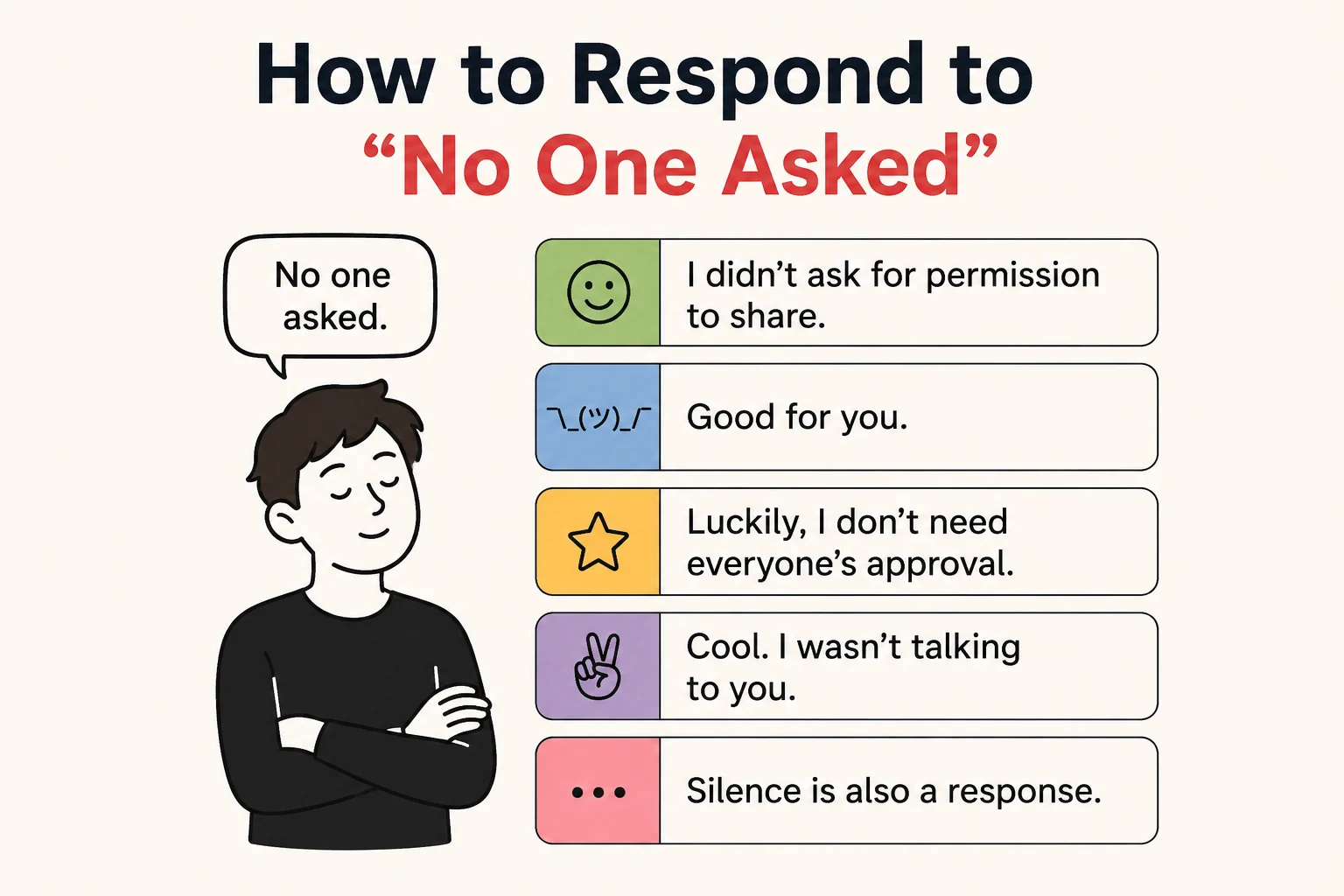
Quick Summary Box 📦
Fast Answer: “No one asked” is a dismissive phrase used to shut down a comment someone didn’t request. The best responses either (1) own it with confidence, (2) flip it into a joke, or (3) disengage entirely. Avoid getting defensive — that’s what gives the phrase its power. Scroll down for 25+ ready-to-use replies sorted by tone and situation.
Introduction: Why “No One Asked” Stings (And Why It Doesn’t Have To)
Knowing how to respond to no one asked can turn an awkward moment into a confident one. You drop a random thought, a fun fact, or an opinion nobody requested — and back comes the internet’s favorite conversational grenade. It’s blunt, it’s dismissive, and it’s designed to make you feel small for speaking up.
This guide breaks down exactly how to respond to no one asked — whether you want to be witty, chill, funny, or just want to shut the conversation down without giving it any more oxygen. We’ll cover comebacks for texting, social media comments, in-person jabs, and situations involving friends, strangers, and outright bullies. For more insights, read here:- How to respond when someone calls you a joke and How to respond to have a good day.
What Does “No One Asked” Actually Mean?
At its core, “no one asked” is a conversational dismissal tactic — whether it’s a comment, a text, or a shout across the room, the goal is the same: make you feel unearned for speaking. It implies a comment is unwelcome or unearned because nobody requested it.
Common variations include:
- “Nobody asked though”
- “Did I ask?”
- “Who asked?”
- “Ok and?”
- “Cool story, no one cares”
- “Sit down, ratio incoming”
- “L take, unbothered”
- “Who invited your opinion?”
- “That’s crazy, anyway…”
- “Asked? No.”
It’s most common in group chats, comment sections, classrooms, and casual banter between friends — and it has become a full-blown internet meme, often paired with reaction images or emojis (💀, 🙄, ✋).
The Psychology Behind Why People Say It
Understanding the “why” makes it easier to respond without getting rattled. People typically say this because:
- They want a quick, low-effort win in a conversation.
- They feel a need to assert dominance or social status.
- Your comment made them uncomfortable or challenged something they said.
- It’s a reflex or bit — especially among younger internet users, it’s just a meme response now, not a personal attack.
- They’re testing your reaction to see if you’ll get flustered.
- Peer pressure or performance — saying it in front of others gets a laugh.
- Genuine boredom or trolling with zero deeper meaning.
- Habitual sarcasm that’s become part of their texting personality.
- They ran out of a real counterargument and defaulted to dismissal.
- They’re mirroring meme culture they saw elsewhere online.
The key insight: most of the time it’s not that deep. Your response doesn’t need to be either — unless you want it to be.
The Golden Rules for How to Respond to No One Asked
A few principles that apply no matter what you say:
- Don’t get defensive. Explaining yourself gives the line power.
- Match the energy, not the aggression. If it’s playful, stay playful.
- Speed matters. A fast, dry reply lands better than an overthought paragraph.
- Silence is also a response. Sometimes not engaging is the strongest move.
- Know your audience. A comeback for your best friend won’t work the same on a stranger online.
- Confidence beats cleverness. A calm reply often beats a “clever” one.
Witty & Sarcastic Comebacks
For when you want to hit back with humor:
- “No one asked, but you replied anyway. Curious.”
- “Neither did I, and yet here we are.”
- “Wow, didn’t realize replies needed a permission slip.”
- “Noted. Filing this under ‘things I didn’t need to know you thought.'”
- “And yet you read it, commented on it, and gave it your full attention. Iconic.”
- “Correct. It’s called sharing, not a Q&A session.”
- “You didn’t need an invite to reply either, but here we are, thriving.”
- “That’s the beauty of the internet — free speech, no permission required.”
- “Adding this to the list of things nobody wanted, right next to your opinion.”
- “True. I do things for me sometimes. Try it.”
Calm & Confident Comebacks
For when you’d rather stay composed and unbothered:
- “Didn’t need to be asked to have a thought.”
- “I’ll allow it. Thanks for checking though.”
- “I said it because I wanted to, not because I needed approval.”
- “Good thing I don’t run my thoughts by a committee.”
- “I’m good sharing without a permission slip, but thanks.”
- “Noted, and moving on.”
- “Appreciate the feedback, doesn’t change anything.”
Funny, Meme-Style Replies
Perfect for group chats:
- “🚨 breaking news: I said a thing without a permit 🚨”
- “Filing a formal appeal to speak freely.”
- “Adding ‘unsolicited thoughts’ to my personality traits.”
- “I’ll take my talking license back now, thanks.”
- “This message was sponsored by absolutely no permission required.”
Turning It Back Into a Joke on Yourself
Sometimes the strongest move is self-deprecating humor — it shows you genuinely don’t care:- “You’re right, I do this for free too.”
- “I speak so my thoughts don’t stay trapped, it’s a whole process.”
- “Unsolicited opinions are kind of my brand at this point.”
- “I contain multitudes, and none of them were requested.”
This works especially well with friends, keeping the mood light rather than combative.
Ignoring It Gracefully (The Power Move)
Not every dismissive jab deserves a reply — with strangers online or people baiting you, the best response is no response at all.
Ways to disengage without looking rattled:
- Don’t reply; continue the conversation with others.
- React with a neutral emoji (👍 or 😂) and move on.
- Change the subject as if the comment never landed.
- Mute or leave the thread if it’s clearly bait.
Ignoring removes the reaction the other person was fishing for. No reaction, no win.
Responding in Text or DMs vs. In Person
In text/DMs: You have time to craft a reply, so lean into wit or a short, punchy line. GIFs and reaction memes work well here too.
In person: Speed and tone matter more than wording. A calm shrug, a light laugh, or a quick one-liner lands better than something scripted-sounding. Confidence in delivery matters more than the exact words.
Responding on Social Media Comments
Social platforms are where this dismissal thrives most:
- On X/Twitter or TikTok comments: Short and dry wins. One-liners outperform paragraphs.
- On Instagram: A witty reply + emoji combo tends to get the most engagement.
- On Reddit: Deadpan, logical comebacks tend to land better than jokes, since the audience there rewards dry wit.
- On YouTube: Longer, more sincere responses can work since comment threads there are less about quick clapbacks.
Related search questions: “what to reply when someone dismisses your comment on Instagram,” “funny reply to ‘did I ask’ on TikTok,” and “best comeback for did I ask.”
When a Friend Says It vs. a Stranger vs. a Bully
Context changes everything:
- A friend saying it is usually a joke — respond with equal playfulness, no need to overthink it.
- A stranger online saying it is often just noise — ignoring or a short dry reply is usually enough.
- A bully or someone genuinely trying to put you down is different — a calm, confident, short response (“Okay, and?”) works better than out-joking them, since it denies them the reaction they want.
What NOT to Say
Avoid these mistakes, which usually make things worse whenever someone says no one asked:
- Long explanations defending why you commented
- Getting visibly upset or typing in all caps
- Insulting them personally instead of responding to the line
- Apologizing for sharing your thought
- Overexplaining your intent — it reads as weakness
Real-Life Usage Scenarios
Scenario 1 — Group chat: You mention a random fact about octopuses. Someone reacts with the classic dismissal: 💀. You respond: “Neither did I, and yet the fact stands.” Chat moves on, you look unbothered.
Scenario 2 — Instagram comment: You compliment a post. Someone says your opinion wasn’t wanted. You leave a simple 😂 and don’t engage further.
Scenario 3 — Classroom or workplace: You offer input and a classmate mutters the line under their breath. A calm “Good thing I offered it anyway” keeps you composed.
Frequently Asked Questions
How do I respond to “no one asked”?
Stay calm, keep it short, or flip it into a joke — for humor, try something like “Neither did I, and yet here we are.” For calm confidence, “Didn’t need permission to have a thought” works well.
Is it meant to be mean?
Usually not personal. It’s often meme-driven or a reflex response rather than a genuine insult, especially among younger internet users.
How do I respond to “did I ask?”
The same principles apply: stay calm, keep it short, or flip it into a joke.
Should I ignore these comments online?
Ignoring is often the strongest response, especially with strangers or obvious bait, since it removes the reaction they’re looking for.
What does it mean when a friend says it?
Between friends, it’s almost always playful teasing rather than a real dismissal.
How do I stay confident when this comes up?
Remind yourself the comment says more about the other person’s need to respond than about the validity of what you said.
Are there funny memes for this?
Yes, many reaction images and short video formats use this dismissal as a punchline, often paired with a dry or deadpan follow-up.
What’s a mature way to handle it at work or school?
A short, neutral reply like “Noted, moving on” keeps things professional while showing you’re unbothered.
Conclusion
At the end of the day, this exchange is a tiny moment of internet slang testing whether you’ll flinch. You don’t have to. Pick a tone that fits, deliver it without hesitation, and let the conversation move on — the words matter far less than the calm you bring to them.